
Vanta vs OneTrust: Which Compliance Platform Is Best for You?
Both Vanta and OneTrust have earned a pretty solid reputation in the compliance software market. But, while they share some overlap, they’re very different in terms of which companies they serve best.
Let’s face it, compliance software isn’t something most companies actually get excited about buying. Even the initial comparison phase, when you’re running Vanta vs OneTrust, or Vanta vs Drata assessments can be exhausting. But that doesn’t mean you can afford to make the wrong choice.
When your investors start whispering “SOC 2” into your Cap Table, and your enterprise customers start sending you Excel files titled “Vendor Risk Assessment – Final FINAL v3,” you need to be prepared – and that’s what the right software does for you.
Both Vanta and OneTrust have earned a pretty solid reputation in the compliance software market. But, while they share some overlap, they’re very different in terms of which companies they serve best. That’s why we decided to create this (simple) head-to-head comparison.
Ready to make a choice you can actually feel confident about?
Let’s dive in.
Meet the Contenders: OneTrust vs Vanta
Let’s start with a simple introduction. Beginning with Vanta – one of the most popular compliance platform solutions around today. Founded in 2018 out of Y Combinator, Vanta quickly became the name every seed-stage founder mutters between deep sighs and VC pitch calls.
It's widely recognized as the first platform to make SOC 2 feel doable without hiring a consultant named Rick who charges $500/hour to tell you to use Google Drive.
Vanta is the polished compliance engine, with a clean UX, and a to-do list you’ll probably procrastinate on. Vanta is loved by founders and fast-growing startups for being plug-and-play, especially when investor due diligence starts breathing down your neck.
But while it’s a champ at telling you what you need to do, it’s not always great at doing it for you. Vanta leans checklist-heavy - the “planner friend” of the compliance party.
Now over to OneTrust.
Launched in 2016, OneTrust is more than a compliance tool. It’s a privacy, governance, third-party risk, ESG, cookie banner, and data mapping empire. This thing does everything. (Whether you want it to or not.) It’s loved by 14,00 customers worldwide, and it leverages AI too!
OneTrust is robust and expansive – though just a little overwhelming for some. It’s great for companies that need advanced privacy and risk workflows, not just a SOC 2 checkbox.
The Compliance Cage Match: Vanta vs OneTrust
Choosing between OneTrust vs Vanta is kind of like comparing a Swiss Army knife to a minimalist multitool. One has 42 features you may or may not need (but looks very impressive in meetings), while the other just works right out of the box, quickly and quietly.
Here’s where the gloves come off. We’re comparing real-world features, performance, pricing transparency, and what it's actually like to live with these platforms once the honeymoon phase (a.k.a. onboarding) is over.
Compliance Framework Support
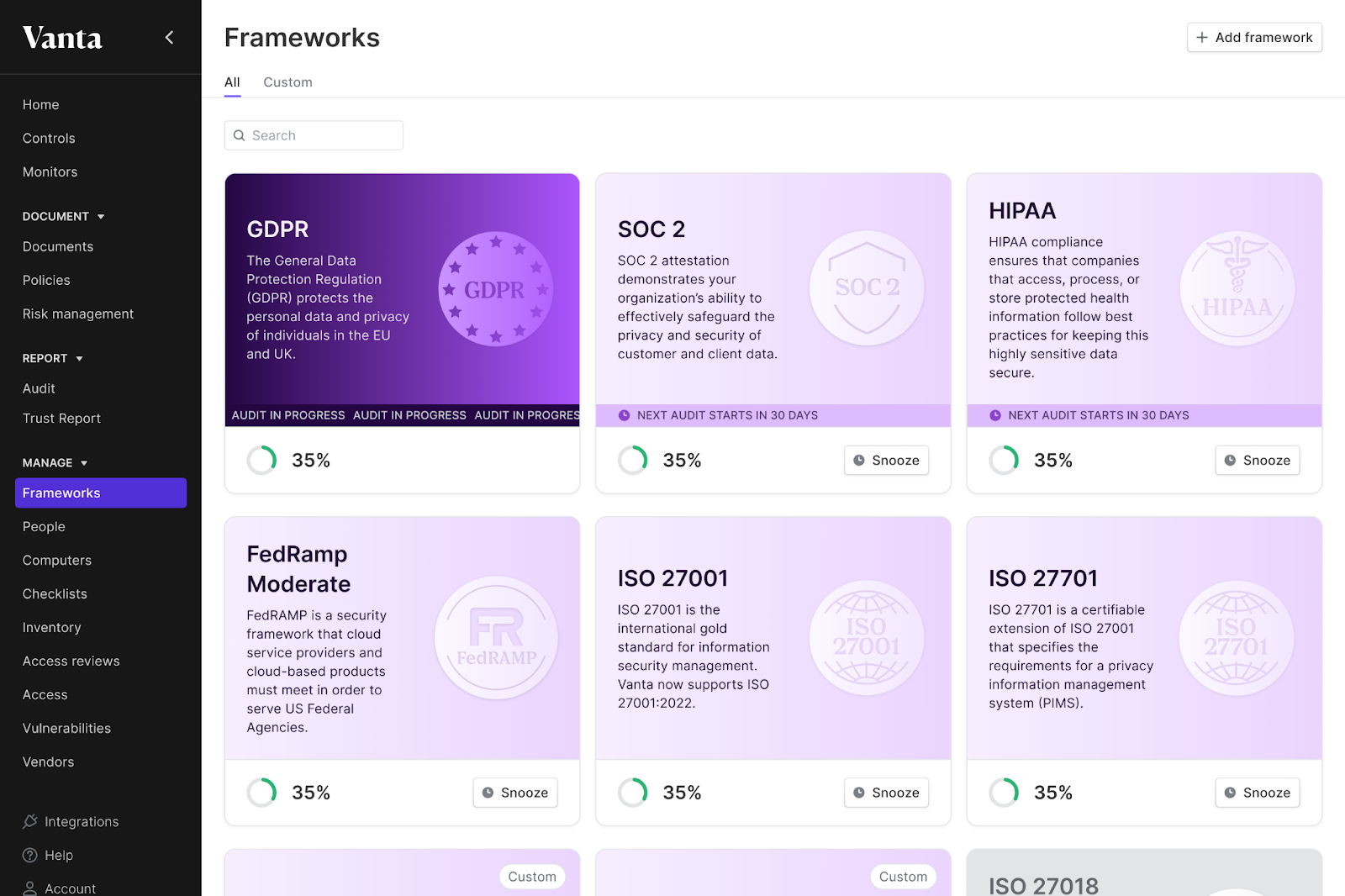
When it comes to frameworks, Vanta keeps things tight and tidy, perfect for startups and scaling SaaS teams. You get support for the usual suspects: SOC 2, ISO 27001, HIPAA, GDPR, and PCI DSS. These frameworks are prebuilt into intuitive templates that can get you audit-ready fast, especially if your primary goal is “get compliant so we can close this deal.”
On the other side of the ring, OneTrust goes full enterprise buffet mode. It doesn’t just stop at SOC 2 or GDP, it covers everything from CCPA and NIST, to ITAR, ESG, ISO 27701, and just about every acronym you can throw at it. It’s designed for companies with global compliance needs, multiple jurisdictions, and regulators breathing down their necks.
Automation & Evidence Collection
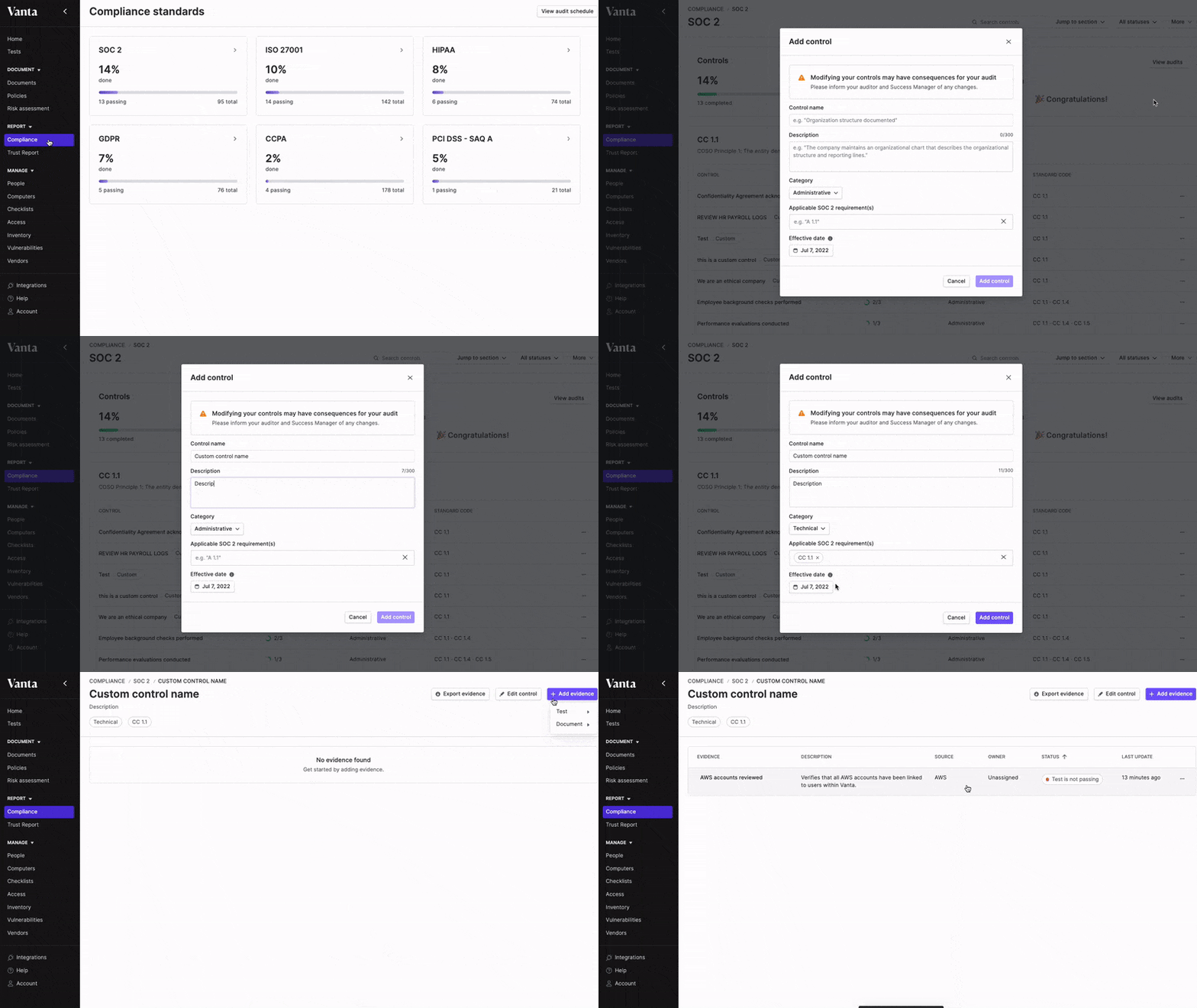
Vanta is often described as “automated”, and to an extent, that’s true. It integrates with 300+ tools (AWS, GitHub, Okta, etc.) and automatically pulls in evidence like access logs and security settings. But you still have to validate and organize much of that evidence when it’s audit time. Think of it as a smart assistant that delivers your groceries, but doesn’t unpack the bags.
OneTrust, meanwhile, is less focused on pulling in logs and more on documentation automation, helping you manage privacy policies, cookie consent, and data usage forms across departments. It automates workflows, not systems. In other words, it’s like hiring a team of policy librarians with clipboards and very detailed spreadsheets.
Risk & Real-Time Monitoring
Risk is where OneTrust stretches its enterprise muscles.
With OneTrust, you can build out comprehensive risk matrices, launch third-party risk assessments, and implement custom scoring models based on the business impact of each control or vendor. It offers an entire suite of TPRM (Third-Party Risk Management) tools, including vendor onboarding workflows, scoring engines, and continuous monitoring. This is real “Chief Risk Officer” territory.
Vanta, by contrast, does a great job with real-time alerts. If a system drifts out of compliance, like an engineer disables MFA, Vanta will ping you. But its risk capabilities are basic. It doesn’t prioritize threats or give you deep mitigation tracking. Think of it as “compliance guardrails,” not full-blown risk forecasting.
Integrations & APIs
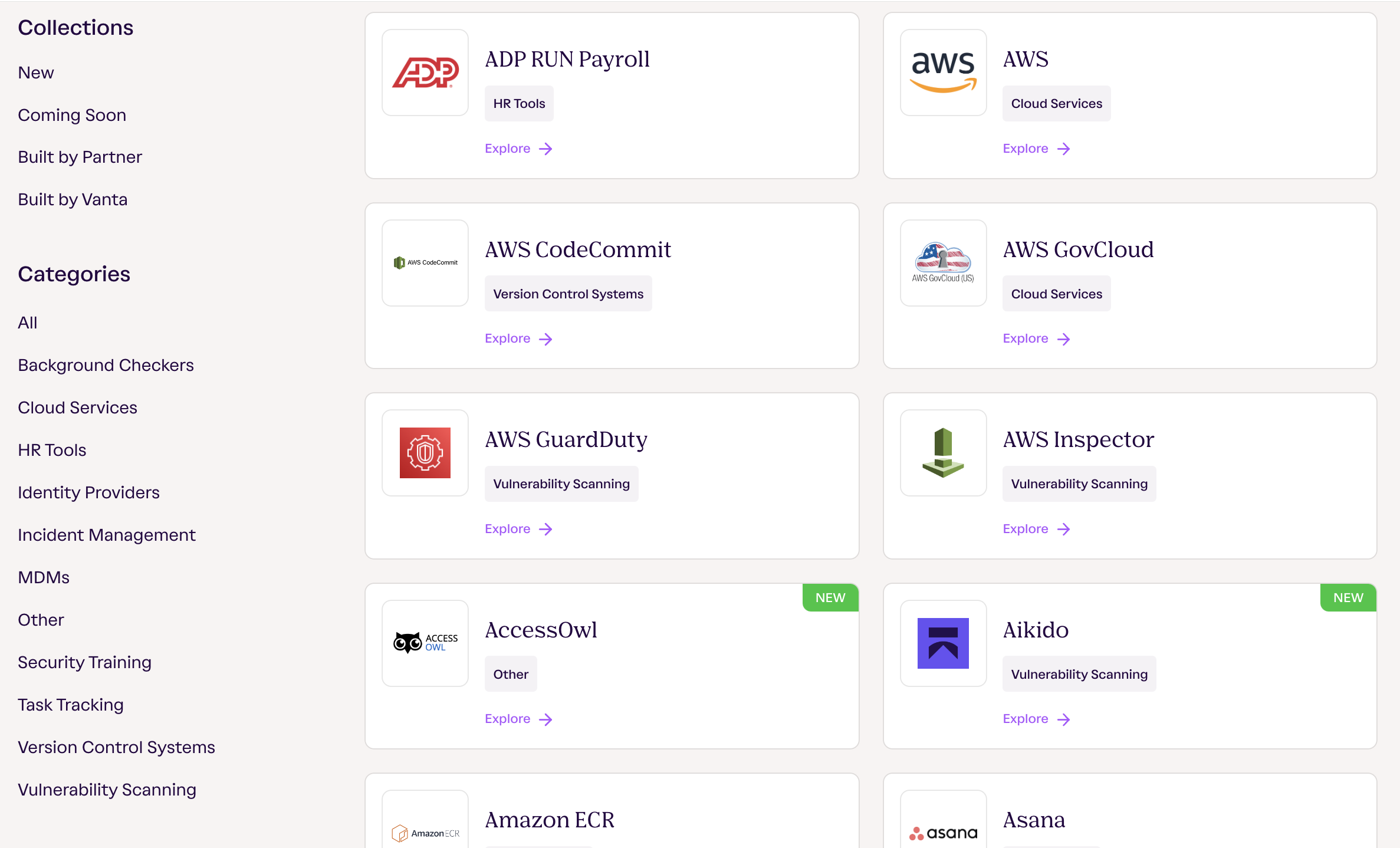
Vanta wins here for speed and ease. With over 300 pre-built integrations, it can connect to most modern startup stacks in just a few clicks. From AWS to Google Workspace to Jira, it’s optimized for the tools your engineers already use. The API is straightforward and dev-friendly, letting you automate what matters without needing a PhD in SDKs.
OneTrust has fewer integrations (about 200+), but they’re deeper. It’s built to work with enterprise-grade systems like Salesforce, SAP, and Workday. But integrating these tools often requires custom configuration, and possibly a few consultants.
User Experience & Onboarding
One of Vanta’s biggest selling points is its simplicity. The platform is clean, clear, and easy to navigate, even for teams without a dedicated compliance officer. Most companies report being “in the green” (audit-ready) within 2–4 weeks. It’s startup-friendly, founder-friendly, and doesn’t overwhelm you with jargon or nested settings.
OneTrust is on the opposite end of the spectrum. The platform is massive, powerful, but dense. The interface reflects that. There are layers of customization, submodules, dashboards, and controls. It’s designed for organizations with teams dedicated to GRC, privacy, and legal.
Pricing Transparency
This is where things get a little complex.
Vanta’s pricing isn’t listed on their website, but reports put them between $10,000–$80,000/year, depending on your team size, frameworks, and the number of integrations you use. Add-ons like pen testing, HR training, or risk modules cost extra.
OneTrust is even more elusive. It uses a modular pricing model, which sounds great in theory but means you pay separately for every feature. Some customers pay under $10K. Others pay over $50K annually. The only consistent thing: you'll need to schedule a call to get a quote, and possibly a second call to understand it.
Support & Customer Success
Vanta offers a hybrid of self-service tools (templates, docs, live chat) and dedicated onboarding teams, though the latter is more available on premium tiers. Most smaller teams report that Vanta’s support is solid, fast, and human. You won’t always get a named rep, but you’ll usually get a reply the same day.
OneTrust’s support, by contrast, is geared for scale. You’ll likely get a named account manager, ticket escalation paths, and scheduled strategy calls. It’s a more traditional enterprise support model. Helpful? Yes. Fast? Not always. Some users report delays of 2–3 days on tickets, though others praise the depth of help once they connect.
Market Positioning: Vanta vs OneTrust
When people ask about Vanta vs OneTrust, they’re not just comparing software. They’re comparing philosophies. It’s like pitting a lightning-fast startup app against a corporate Swiss Army knife and asking, “Which one’s better?”
Well, it depends: Are you building a SOC 2 program in a WeWork with 2 engineers and 14 Trello cards? Or are you a publicly-traded behemoth with a Chief Privacy Officer, three compliance committees, and a folder structure that would scare anyone?
Vanta: The Fast-Moving Startup Darling
Vanta has one clear message: Get compliant, fast. It was born in the Y Combinator world where SOC 2 is less a framework and more of a rite of passage between seed and Series A.
Their ideal customer? A tech startup under 100 employees, looking to knock out compliance so they can close their next deal. Vanta’s biggest promise is speed and simplicity.
Pros:
Lightning-fast onboarding (2–4 weeks)
Clean, intuitive UI
Great for VC-backed teams looking for quick wins
Cons:
As companies scale, the “checklist” model gets limiting.
Complex risk programs and multi-framework needs start to feel clunky.
“Automated” means integrations, not always outcomes.
OneTrust: The Corporate GRC Powerhouse
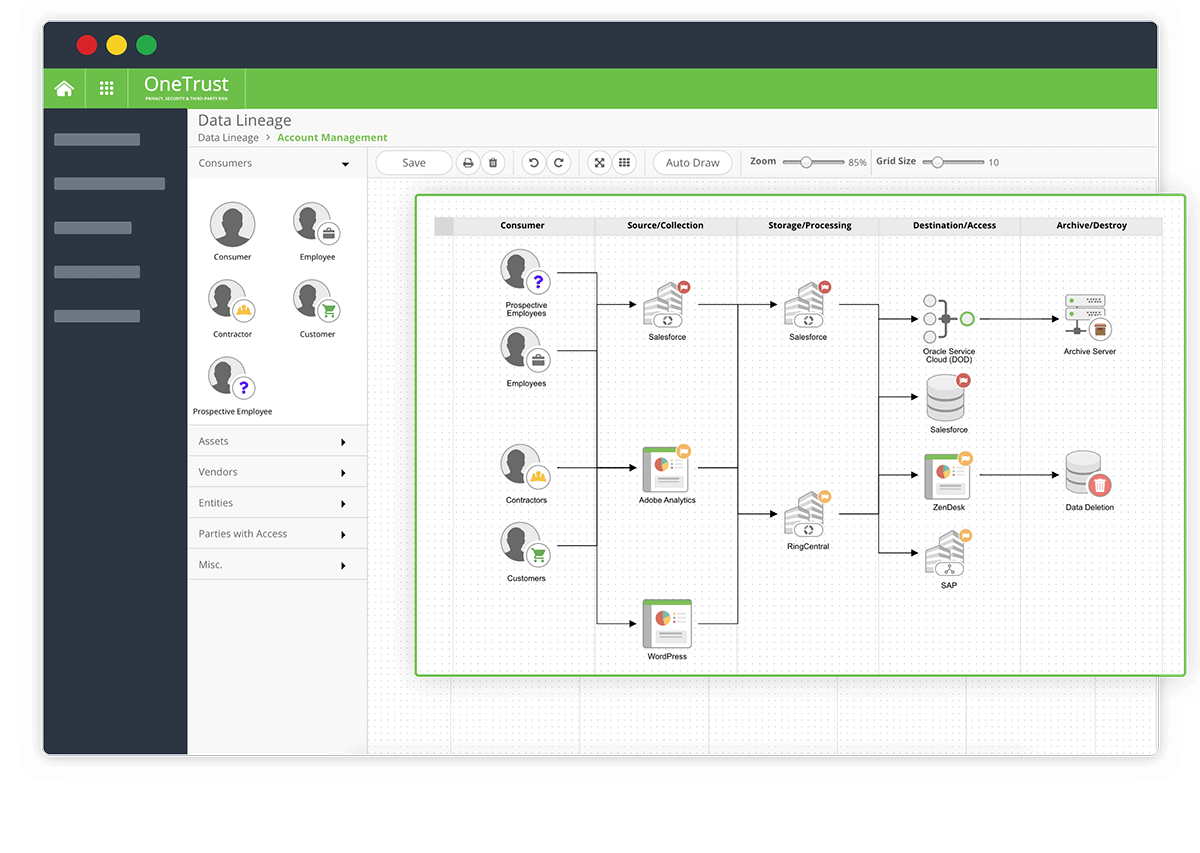
Where Vanta is sleek and scrappy, OneTrust is more of a compliance empire. Its modules cover everything from privacy programs and data governance to ESG reporting and third-party risk management.
Their ideal customer? A legal or security team at a mid-market or enterprise org with real compliance infrastructure and a strong stomach for complexity.
Pros:
Deep privacy features and enterprise-grade control
Ideal for global organizations or those in regulated industries (finance, healthcare, etc.)
One-stop shop for GRC, privacy, risk, ESG, ethics, and IT compliance
Cons:
Setup is not for the faint of heart
Configuration is complex and time-consuming
You may need consultants just to understand what you’ve bought
What If You’re Neither?
Maybe you’re not a baby-faced startup, nor a Fortune 500 monolith. Maybe you’re a lean, fast-moving SaaS team, trying to hit compliance targets without burning out.
That’s where many companies say, “Hard pass” to both Vanta vs OneTrust, and start looking for something:
Easier to onboard than OneTrust
More automated than Vanta
More affordable than both
That's where EasyAudit comes in.
Why Many Companies Turn to EasyAudit Instead
If you’ve made it this far through the Vanta vs OneTrust saga, you might be thinking:
“Okay, but why does compliance software feel like buying a car in 2003? Confusing pricing, vague promises, and I still have to do half the work myself?”
Exactly. That’s why a growing wave of fast-scaling startups and savvy mid-size teams are skipping the complexity (and cost) of Vanta and OneTrust, and choosing something radically simpler, smarter, and more automated.
Here’s why companies are shifting to EasyAudit:
1. Compliance Officer-as-a-Feature
While Vanta gives you checklists and OneTrust gives you modules, EasyAudit gives you a full-blown AI Compliance Officer who actually helps.
Ask it questions in plain English (“What controls am I missing for SOC 2?”)
Get real-time answers, recommendations, and task guidance
No need to chase consultants or decode policy docs at midnight
It's like ChatGPT, but it moonlights as your CISO.
2. Faster Time to Compliance
Vanta and OneTrust might promise fast onboarding, but real users say:
Vanta’s still checklist-driven: automation helps, but follow-through is on you
OneTrust’s onboarding can feel like implementing Salesforce – complicated.
With EasyAudit:
SOC 2 readiness in weeks (not months)
Predictive control mapping
One-click policies and live control validation
EasyAudit helps you half the time it takes to reach compliance, and stay on top of risks constantly.
3. Real-Time Security + Risk Monitoring
Unlike OneTrust’s static assessments and Vanta’s delayed alerts, EasyAudit runs continuous monitoring that flags:
Failing controls
Misconfigured systems
Risk gaps you didn’t even know existed
It’s preventative compliance, not reactive cleanup.
4. Tailored to Your Stack (Not the Other Way Around)
Tired of shoehorning your tools into a template? EasyAudit:
Maps controls to your actual stack
Auto-adjusts policies to your environment
Supports your existing infra without a 17-tab setup process
Whether you’re AWS-native or working with a Frankenstein combo of GCP, Notion, and a Trello board, EasyAudit adapts.
5. Predictable Pricing
Let’s talk money.
Vanta: $10K–$80K/year, depending on team size, frameworks, and add-ons.
OneTrust: Modular pricing that gets expensive, fast (hello, pay-per-user nightmare).
EasyAudit: Flat-rate pricing. No surprises. No weird upsells. Just clarity.
Who Wins in the Vanta vs OneTrust Face-Off?
Let’s make it simple, because if your head is spinning from SOC 2, GDPR, ISO 27001, and the subtle existential dread of audit season, you deserve clarity.
Choose Vanta if:
You’re an early-stage startup or Series A rocketship
You need SOC 2 compliance fast
Your team likes checklists, but doesn’t want to write policies from scratch
You’re okay with some manual review in exchange for a pretty interface
Choose OneTrust if:
You’re an enterprise with real compliance infrastructure
You have a dedicated team for privacy, GRC, and vendor risk management
You need to comply with everything (CCPA, GDPR, ISO, ITAR, ESG, etc.)
You’re okay with complex onboarding, custom modules, and high costs
Alternatively, skip both and head straight to EasyAudit if:
You want to get compliant without a compliance degree
You’d rather let AI build your policies, map your controls, and validate your stack
You’re looking for actual automation, not “click here to manually upload a screenshot”
You want transparent, flat pricing and time to audit in weeks, not months
Ready to rethink compliance? Reach out to EasyAudit and request your free demo today.
FAQs
Which is better for SOC 2: Vanta or OneTrust?
Vanta wins here, hands down. It’s built around SOC 2 and has tight integrations for fast evidence collection. OneTrust can do SOC 2 too, but it’s like using a cargo ship to deliver a pizza.
Which is better for privacy compliance: OneTrust or Vanta?
OneTrust, no contest. Its privacy tools, cookie consent modules, and global policy engines are built for CCPA, GDPR, and everything in between. Vanta doesn’t play in this league.
Can I migrate from Vanta or OneTrust to something else?
You can, but expect some friction:
Control mappings may not translate 1:1
You’ll likely redo some documentation
Good news: tools like EasyAudit offer guided migrations with AI that remaps controls in seconds
What’s the best alternative to both?
EasyAudit. It was built to solve real problems, giving you a compliance platform where AI handles the grunt work, real-time monitoring replaces checklists, and you’re not paying $50K to copy-paste policies into Jira.