A customer, a cyber insurer or the board has asked which framework your security program follows. Most organizations reach for the NIST Cybersecurity Framework, and the honest answer right now is that nobody internally wants to stand it up, score it and keep it scored. The question is on the table, and the date has a name attached.
That is where most searches for the best NIST CSF compliance services start, and one fact should be settled before anything else. NIST CSF is a voluntary framework. There is no certificate, no attestation and no pass.
What you get instead is a scored picture of your program across six Functions, a target you can defend to whoever asked, and evidence a third party will accept when they check. The only durable proof is that evidence, which is why what happens after the assessment matters more than the assessment.
Every provider in this guide delivers that in one of three ways.
Software gives your team a system to configure and operate: it maps the framework and tracks the gaps, and your people close them and keep the score current.
Software with an expert layer adds people who guide that work; the work is still yours.
A service performs the work, or in a consultancy's case, performs the assessment and hands you the roadmap.
So ask yourself what you are buying. If you have a security team and want control of the program, you want software, and the choice is about scoring depth and integrations. If you need a one-time score for the board or an insurer, you want a consultancy, and the choice is about methodology and price.
If you need the program executed and kept scored, because the customer is asking and nobody internal is going to run it, the choice is narrower than this list suggests: one provider here performs the work, keeps the evidence current, and carries the CSF program into the certifiable frameworks that do carry an audit.
This guide compares 9 NIST compliance companies on those terms: five software platforms your team operates, one platform with a bundled expert layer, two consultancies, and EasyAudit, which performs the work as a service.
We built EasyAudit, so read our take on our own service with that in mind. The scoring is published below, and we scored ourselves on the same seven criteria as everyone else.
The verdict in a nutshell: EasyAudit is the best overall pick for regulated companies running NIST CSF as the backbone of their security program, with SOC 2 or ISO 27001 coming next, that want the work performed for them rather than a system to operate.
The Compliance Simulation is free, takes about 75 minutes of scheduled time across two calls, and the report is yours either way. Secureframe is the strongest platform with an expert bench included. CyberSaint is the pick for a large enterprise that wants NIST-native Tier scoring and cyber risk quantification in one place.
CBIZ Pivot Point Security is the consultancy to shortlist for a scoped assessment with a vCISO behind it, and Vanta remains the strongest platform for a GRC team that wants to drive its own program.
Best Overall | Best Platform With In-House Expert Support | Best for Enterprise Cyber Risk Programs | Best Consultancy for a Scoped Assessment |
EasyAudit | Secureframe | CyberSaint | CBIZ Pivot Point Security |
Best NIST CSF Compliance Services: Comparison Chart
Provider | Best For | Delivery Model | What They Do For You | What Stays On Your Team | Frameworks | Starting Price | Score |
EasyAudit | Best Overall | Service | Runs the program: controls mapped to every CSF 2.0 subcategory, policies written, evidence collected continuously, fixes prescribed, readiness scored per framework. A named human expert leads. | Business knowledge, review, sign-off. Under ten hours a year in steady state. | NIST CSF 2.0, SOC 1, SOC 2, ISO 27001, ISO 42001, ISO 9001, CMMC on one control library | Fixed at signature, from the free Simulation. | 8.9 |
Secureframe | Best Platform With In-House Expert Support | Software + experts | Platform with an in-house compliance expert bench; out-of-the-box NIST CSF 2.0 support. | Operating the platform, remediation, policy customization, evidence outside integrations. | NIST CSF 2.0, SOC 2, ISO 27001, HIPAA, PCI DSS, GDPR, CMMC and 40+ others | Quote only. Vendr median about $20,000 per year (16 purchases, 2026). | 7.3 |
Vanta | Best for In-House GRC Teams | Software | Platform: continuous monitoring, policy templates, evidence collection, NIST CSF as a supported framework. | Everything the platform flags: policies, remediation, scoring upkeep. | NIST CSF, NIST AI RMF, SOC 2, ISO 27001, ISO 42001, HIPAA, GDPR | AWS Marketplace 1 to 20 employee bands from $14,000 per year; frameworks priced separately. | 7.0 |
CBIZ Pivot Point Security | Best Consultancy for a Scoped Assessment | Service | Consultancy: NIST CSF 2.0 gap assessment, vCISO, internal audit, roadmap. Assesses and advises. | Remediation and program operation between assessments unless vCISO hours are scoped. | NIST CSF 2.0, NIST SP 800-171, CMMC, ISO 27001, SOC 2, HITRUST, PCI | Quote only, scoped by engagement. | 6.9 |
Drata | Best for Engineering-Led Programs | Software | Platform: continuous control monitoring, policy center, NIST CSF 2.0 activated from the frameworks page. | Everything the platform flags: remediation, policies, scoring upkeep. | NIST CSF 2.0, SOC 2, ISO 27001, HIPAA, GDPR, PCI DSS | Quote only. Vendr median reported between about $24,600 and $38,000 per year by dataset (2026). | 6.9 |
BSI | Best for a Framework-Agnostic Maturity Assessment | Service | Consulting practice: NIST CSF 2.0 maturity assessment with threat workshops, current and target maturity levels and a mitigation roadmap. | Remediation and program operation after the assessment. | NIST CSF 2.0, NIST SP 800-53, NIS 2, ISO 27001 | Quote only, scoped by engagement. | 6.8 |
CyberSaint | Best for Enterprise Cyber Risk Programs | Software | CyberStrong platform: NIST CSF 2.0 benchmarking with Tier 1 to 4 scoring, crosswalks, cyber risk quantification, executive reporting. | Configuring and operating the platform, remediation, evidence. | NIST CSF 2.0, NIST SP 800-53, 60+ frameworks | Quote only, flat-rate model per Capterra; free trial listed. | 6.8 |
Apptega | Best for MSP-Delivere d Programs | Software | Platform: NIST CSF program tracking control by control, task assignment, risk rating, reporting; widely used by MSPs to run client programs. | Configuring and operating the platform, remediation, evidence, unless an MSP runs it for you. | NIST CSF, CMMC, SOC 2, ISO 27001, HIPAA and others | Starting price listed at $9,950 per year (Software Advice); free trial available. | 6.4 |
LogicGate | Best for Customizable Risk Workflows | Software | Risk Cloud: no-code GRC workflows, risk register, control mapping, dashboards and heatmaps. | Building the workflows, configuring the platform, remediation, evidence. | NIST CSF and custom frameworks through configurable applications | Custom quote only; no free trial. | 5.9 |
Delivery model: Service means the provider's people perform the work or the examination. Software plus experts means a platform your team operates, with a bundled human advisory layer that guides rather than performs. Software means a platform your team operates, with support but no service layer.
Data current as of September 2026. Where a figure appears, it is an entry SKU from a public marketplace listing or an observed range from a third-party transaction dataset, attributed inline. Contact each provider for a quote.
How We Evaluated These NIST CSF Compliance Services
Every provider here was scored one to ten on seven criteria, then weighted. The weights are published so you can add up the numbers yourself. They come from what buyers ask about before they buy, not from where any one provider is strongest: how the work gets done, what it costs and on what terms, how long it takes, and how the audit is handled.
Our Scoring Methodology
Criterion | Weight | What we looked for |
Work performed for you versus work left on your team | 25% | Who writes the policies, maps the controls, chases the evidence and talks to the auditor. The single biggest question on 60 percent of sales calls. |
Pricing clarity and commitment terms | 20% | Whether a buyer can see a program price before signing, what the second framework costs, and what happens at renewal. Pricing questions appear on 51 percent of calls. |
Timeline certainty and consequence if missed | 15% | Whether the provider commits to a date, and what it costs the provider if the date slips. |
Assurance handling and independence | 15% | Who issues the result, whether that party is a licensed CPA firm or an accredited certification body where the framework requires one, whether the provider that prepared you can also sign, and how independence is documented. |
Carry-over into certifiable frameworks | 10% | Whether the CSF program's controls and evidence carry into SOC 2, ISO 27001 or NIST SP 800-171 when a certifiable framework follows, or start a new project. |
Environment fit | 10% | Microsoft-heavy estates, on-prem systems, data center and contact center floors, and other operations that cloud-native tooling was not built for. |
Evidence a third party will accept | 5% | Approvals recorded with who and when, an audit trail the application cannot bypass, and read-only access for the auditor, certification body or reviewer. |
On this page EasyAudit scores 7 rather than 10 on timeline certainty, because the Simulation produces a dated timeline for the CSF program but no fee is at risk on CSF itself; the fee-at-risk guarantee attaches only to the certifiable frameworks the program maps into.
We weight the first criterion heaviest because it is where NIST CSF programs fail after the assessment. A platform that maps all 106 CSF 2.0 subcategories still returns every gap to the customer's engineers. A consultancy that scores you across the six Functions hands you a roadmap and leaves.
Because there is no audit to force the issue, the score goes stale quietly, and the buyer discovers it when a customer or insurer asks for the evidence behind last year's number.
Provider | Work (25%) | Pricing (20%) | Timeline (15%) | Assurance (15%) | Multi-framework (10%) | Environment (10%) | Evidence (5%) | Weighted |
EasyAudit | 10 | 8 | 7 | 9 | 10 | 9 | 9 | 8.9 |
Secureframe | 7 | 7 | 6 | 9 | 8 | 7 | 8 | 7.3 |
Vanta | 6 | 7 | 6 | 9 | 8 | 6 | 9 | 7.0 |
CBIZ Pivot Point Security | 7 | 5 | 6 | 8 | 7 | 9 | 9 | 6.9 |
Drata | 6 | 6 | 6 | 9 | 8 | 7 | 9 | 6.9 |
BSI | 6 | 5 | 6 | 8 | 8 | 9 | 10 | 6.8 |
CyberSaint | 5 | 6 | 5 | 10 | 8 | 9 | 8 | 6.8 |
Apptega | 5 | 7 | 5 | 8 | 7 | 7 | 7 | 6.4 |
LogicGate | 4 | 5 | 5 | 8 | 8 | 7 | 8 | 5.9 |
Weighted totals are rounded to one decimal. The score on each provider entry, the score in the comparison chart, and this table reconcile. Ties are broken on the first criterion, then the second. Every provider carries identical scores on every page of this series; the one exception is EasyAudit's timeline score on the NIST CSF page, explained there, because no fee is at risk on CSF itself.
9 Best NIST CSF Compliance Services in 2026 Reviewed
What is the best NIST CSF compliance service? The one that scores your program across all six Functions, keeps that score true after the assessment, and carries the work into SOC 2 or ISO 27001 when a customer asks for a certificate next. Here is how the top NIST CSF compliance services of 2026 compare on that test, ranked by the score above.
1. EasyAudit
Best for: regulated companies running NIST CSF as the backbone of their security program, with SOC 2 or ISO 27001 coming next, that want the work performed for them rather than a system to operate.
Compliance Service Score: 8.9/10
Service Overview
EasyAudit is a compliance service for organizations that have to show a framework-based security program and do not want to run it themselves. A named human compliance expert leads your engagement from start to finish, the AI Compliance Officer executes the recurring work, and the platform is the shared foundation and memory. One service, not three products.
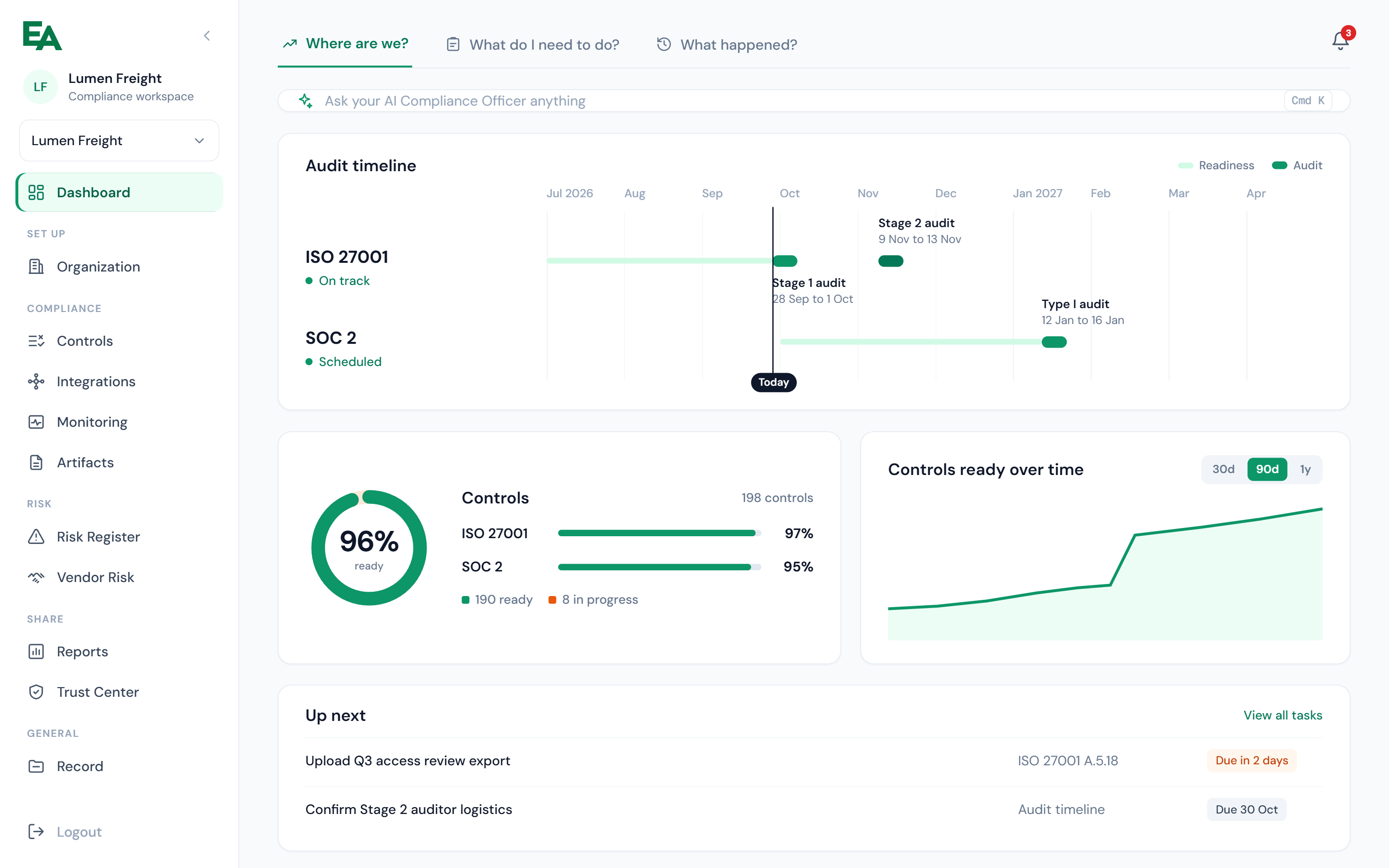 If a customer, an insurer, a board or a contract has asked which framework you follow, and your security, engineering and legal people are the ones who would otherwise absorb the program, we built it for you, and we built it for regulated companies: the ones whose customers, regulators, insurers or contracts require proof, in whatever industry that pressure arrives.
Two things set us apart in this guide:
We diagnose before you commit, at no charge: the free Compliance Simulation runs on your real environment and returns your readiness, gaps, timeline and price before you sign anything.
Then the CSF program does not stand alone: it runs on the same control library as SOC 2 and ISO 27001, so when the certifiable framework arrives, the work is already done.
The 3 NIST CSF Problems We Built EasyAudit to Solve
The program work lands on your team
Every other delivery model in this guide, as each provider describes it, leaves the remediation with your team. A platform maps the 106 subcategories and flags the gaps; your engineer closes them, your ops lead writes the policies, your one compliance person keeps the score current. A consultancy scores you and leaves a roadmap.
Nobody else on this list performs the work between the assessment and the next time someone asks.
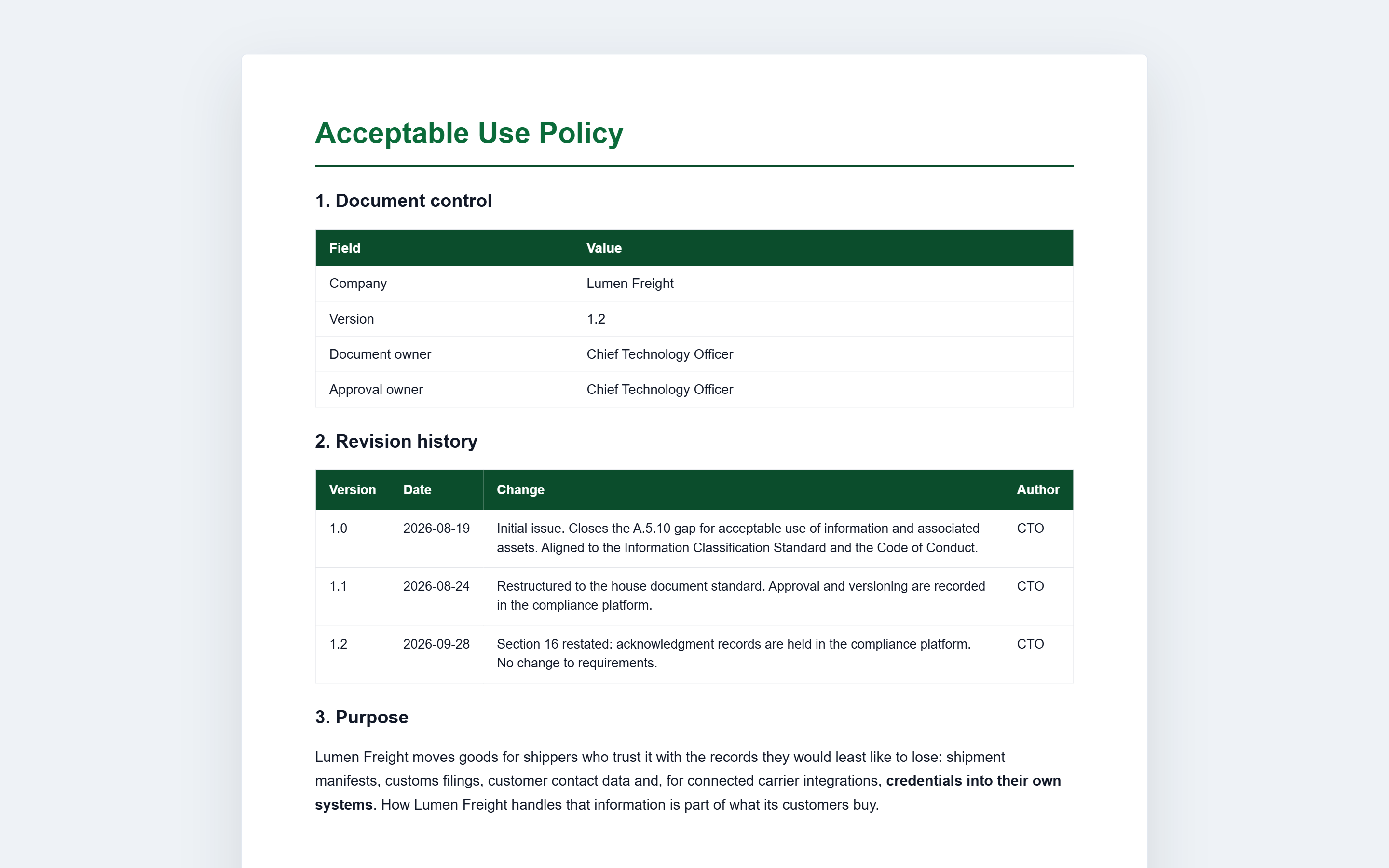
We transfer the work. Our AI Compliance Officer drafts the policies, collects the evidence, and prescribes the exact fix for every gap under every Function. Our named compliance expert reviews every piece of work and owns the program. Your team reviews and signs. The work does not disappear. It changes owners.
A scored assessment goes stale the week after it is produced
A NIST CSF score is a point in time. The environment changes every week: a permission granted, a vendor added, a service deployed. The number the board saw in March says nothing about September, and because there is no audit to force a refresh, nobody notices until a customer or insurer asks for the evidence behind it.
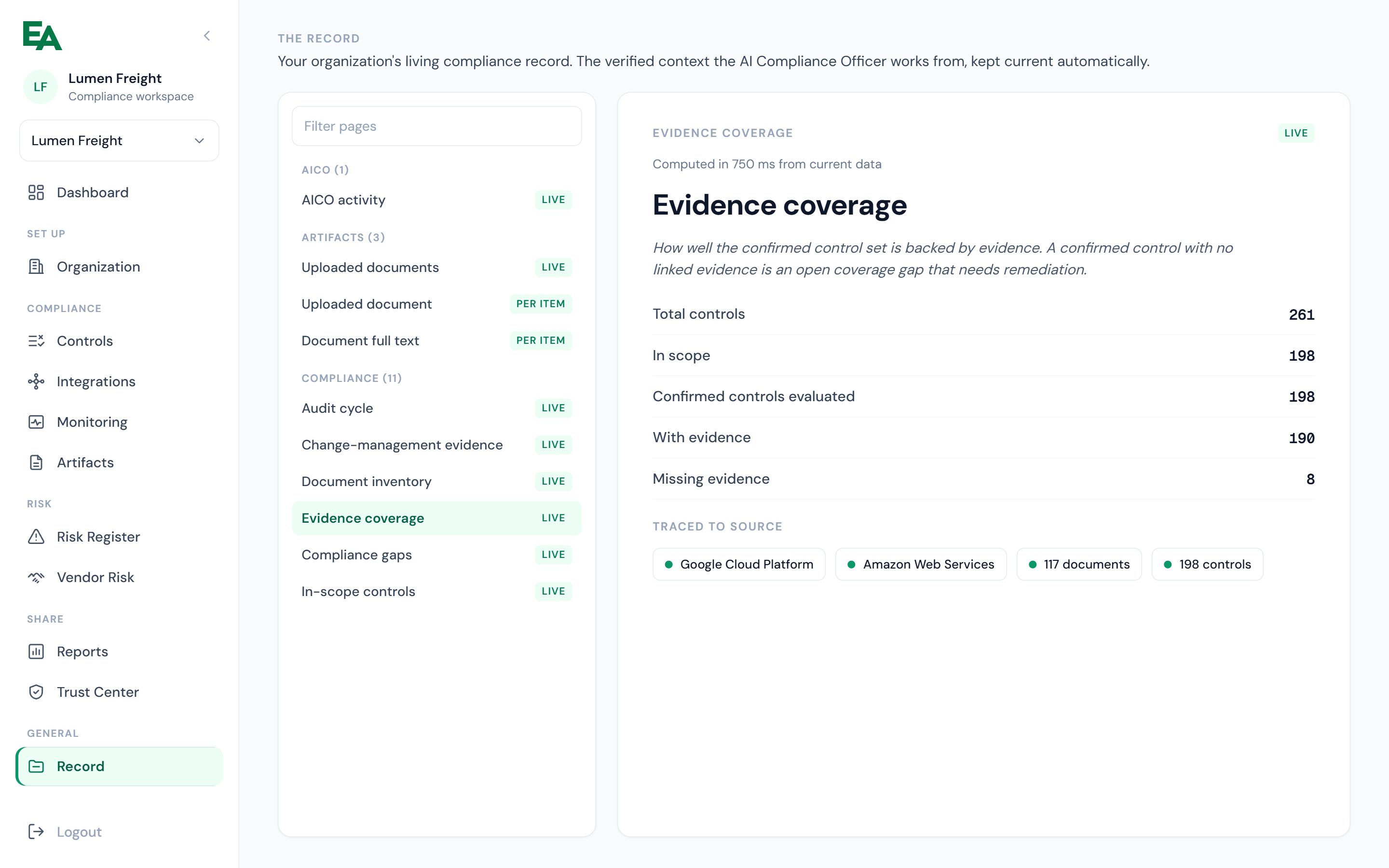
We keep the evidence current. 3,950+ continuous monitoring checks run against the controls behind your assessment, every change is detected, diagnosed and prescribed, and the Record shows what is true today, traceable to source. Nothing stays correct on its own. Continuous compliance is what makes the score worth showing.
CSF work has to be redone when a certifiable framework follows
Most organizations adopt NIST CSF first and need SOC 2 or ISO 27001 within two years, when a customer stops accepting a self-scored framework and asks for a certificate. With most providers that is a new project, a new control set and the same evidence collected again.
We run one control library that every framework maps into. A control implemented for a CSF subcategory satisfies SOC 2 and ISO 27001 wherever they ask for it. One control satisfies up to seven frameworks, one evidence set covers all mappings, and the program carries 60 to 70 percent fewer controls than running frameworks in parallel. Your CSF program becomes the foundation for every framework that follows.
Frameworks Covered
NIST CSF 2.0, SOC 1, SOC 2, ISO 27001, ISO 42001, ISO 9001 and CMMC. One control library sits under all seven, so one control can satisfy up to seven frameworks and the program carries 60 to 70 percent fewer controls than running frameworks in parallel.
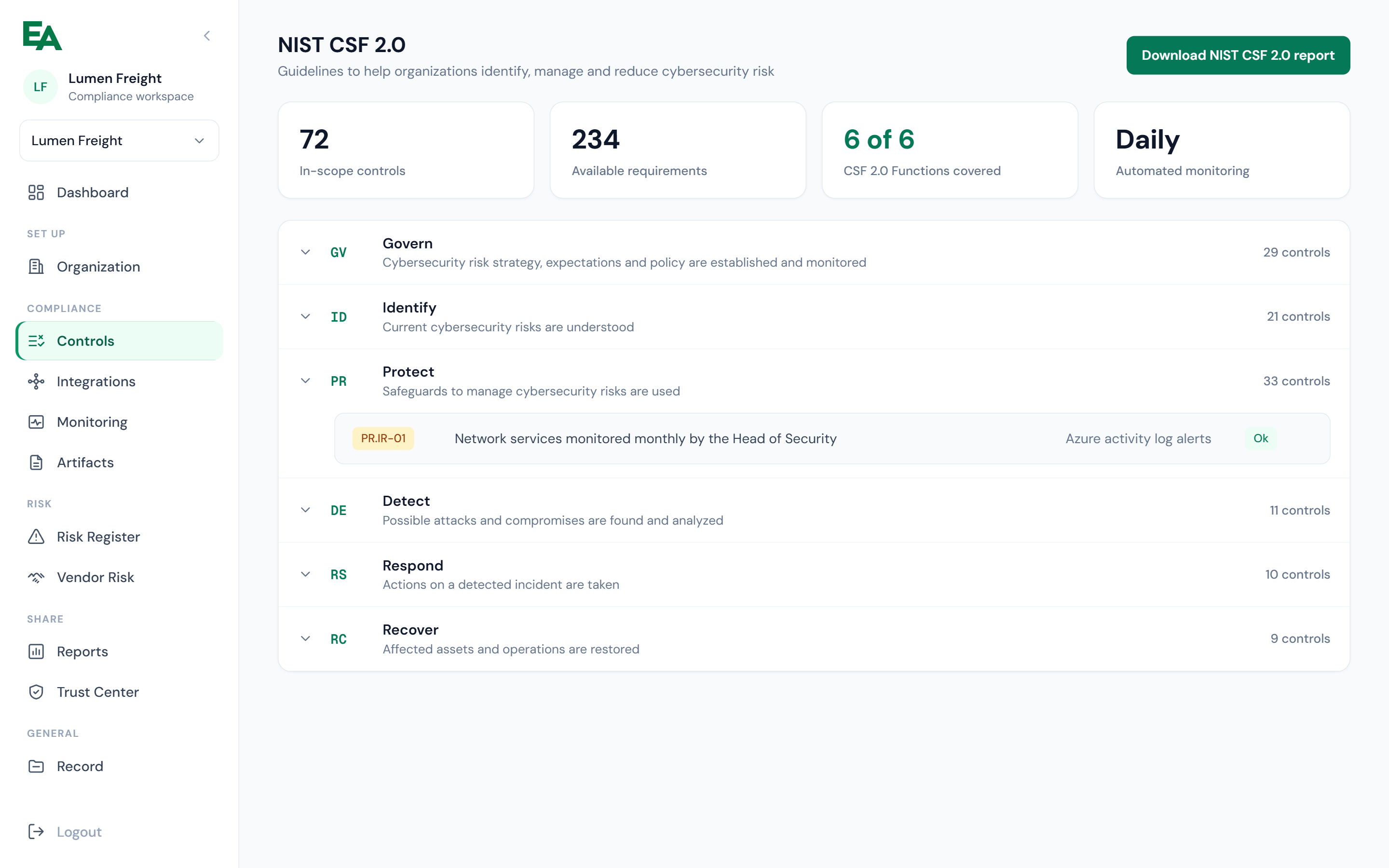
NIST CSF 2.0 controls map into NIST SP 800-171 for CMMC and into SOC 2 and ISO 27001 for the certifiable path.
How Maturity Is Scored
NIST CSF 2.0 organizes outcomes into six Functions: Govern, Identify, Protect, Detect, Respond and Recover. We map your controls to every subcategory under each Function, so the score is built from what is verified in your environment, not from a questionnaire.
The Compliance Simulation produces your readiness per framework before you sign, on your real environment: what is in place and verified, what is missing, and what it will take to close each gap. Your Current Profile is what the Record can prove today. Your Target Profile is the scope you approve.
The gap between them is the work, and the dated timeline is how long it takes us to close it. You approve the scope and the target; we produce the score and the evidence behind it.
Because the evidence is monitored continuously, the score does not depend on someone remembering to re-run the assessment. When a customer, insurer or board asks for the number, the number reflects the current state of your environment, with every control traceable to its source.
Pricing
The investment is fixed at signature, from the Compliance Simulation run on your own environment. The Simulation Report includes readiness per framework, every material gap prioritized, the work required, a dated timeline, the investment, and a written recommendation from the expert who ran it. The report is yours either way. For a directional figure before the Simulation, use the cost calculator.
There is no certification body fee for NIST CSF, so the comparison that holds is against the recurring cost of keeping the program true: consultant hours for each re-assessment, platform operation, and the internal time your team spends between them. We replace all three. We are not the lowest-priced option in this guide, and we say so under Tradeoffs.
What Stays On Your Team
Under ten hours a year from your team in steady state, because the recurring work transfers to us rather than shrinking on your calendar. Your team supplies business knowledge, reviews key decisions, and signs where its authority is required: the scope, the target profile, the risk register, the policies. We write the policies; your team reviews and signs.
Controls are accepted in one click with who-approved-and-when recorded. One 15-minute meeting closes three to four evidence items. Signed-statement templates mean you never hit a dead end.
Setup
The Compliance Simulation runs on your real environment in about 75 minutes of scheduled time across two 30-minute calls. A mutual NDA is signed the same day, documents go into a workspace without cleanup, a scoping questionnaire is completed, and read-only connections go live on the first call.
The environment is pre-built before you join the second call, where decision makers see readiness per framework, gaps, scope, price and the timeline on their own data. Access is read-only by design, using temporary credentials and OAuth.
Tradeoffs
We are not built for a 1 to 10 person company or a team that only needs a one-off CSF scorecard with no framework work behind it; a consultancy engagement is the rational choice there, and we disqualify the smallest buyers at the booking form.
A large GRC team that wants to model quantitative cyber risk itself will be better served by CyberSaint or LogicGate, which are built to be configured and operated by the customer. An organization that wants a single scoped assessment and a report will prefer CBIZ Pivot Point Security or BSI. We cost more than a software seat.
And NIST CSF carries no certificate and no pass, so the Audit-Ready Guarantee applies to the certifiable frameworks your CSF program maps into, SOC 2 and ISO 27001, not to CSF itself: audit-ready and submitted by the committed date, or you do not pay, for eligible engagements, with the independent auditor or certification body deciding the result.
Support
Your named compliance expert owns the engagement end to end. They set the plan, check every piece of work, present the score and the evidence behind it to whoever asked for it, and you hear from them every two days.
If the controls require it, they attend your facility: data center floors, contact center floors and FDA-regulated manufacturing are inside scope. You never have to log in; you always can.
Mini Case Study
Alignd is a founder-led software company with no security team and, when it started, no compliance documentation at all. No customer had required a framework yet; the founders simply knew the question was coming and wanted a program in place before it did.
We learned the company through a short intake and a scan of its environment, generated the risk register, produced controls fitted to its stack, wrote every required policy from nothing, and attached the evidence to each control for the CPA firm to review. Alignd now monitors its controls continuously and re-certifies without starting over.
2. Secureframe
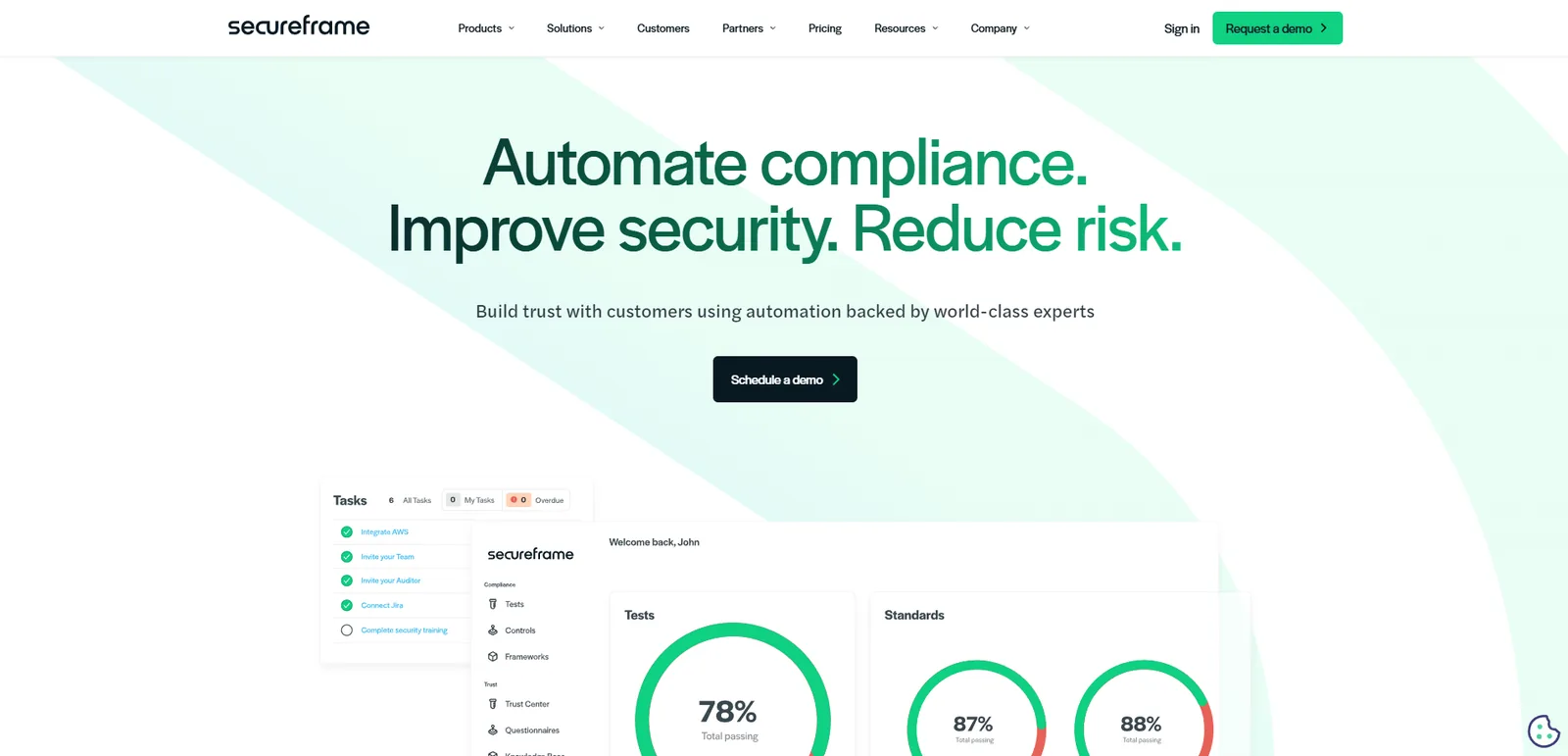
Best for: teams that want software they operate themselves with an in-house expert bench included in the subscription and out-of-the-box NIST CSF 2.0 support.
Compliance Service Score: 7.3/10
Secureframe is a compliance automation platform that includes an in-house compliance expert bench as part of the service, and it announced out-of-the-box support for NIST CSF 2.0 in May 2024. The experts guide the customer's team through the program rather than performing the work.
Product Overview
Continuous monitoring across 150-plus integrations, policy templates, personnel and vendor management, risk management, questionnaire automation and a Trust Center. NIST CSF 2.0 is mapped across the six Functions, and the same platform runs SOC 2, ISO 27001, HIPAA, PCI DSS and CMMC, so a CSF program can be extended when a certifiable framework follows. Plans are Fundamentals, Complete and Federal.
Pricing
Quote only. Vendr's transaction dataset shows a median contract of about $20,000 per year across 16 purchases in 2026, with single-framework contracts commonly in the $12,000 to $25,000 range and enterprise multi-framework contracts running to $60,000 or more. Each additional framework carries an incremental fee, reported at roughly $7,500 per year by third-party guides.
What Stays On Your Team
Operating the platform, customizing policies from templates so they read as true for your environment, closing every failing test, and collecting evidence outside the integrations. The expert bench guides that work; it does not perform it. Keeping the CSF score current between assessments is your team's job.
Setup
Quote-led, then onboarding: integrations connect early and Secureframe's experts support kickoff and evidence review. Timeline depends on gap volume and your team's remediation pace.
Tradeoffs
Secureframe is a good fit for a team that wants a platform and a knowledgeable voice on the other end, without paying for a separate consultant, and that plans to add SOC 2 or ISO 27001 later on the same platform.
Buyer reviews on G2 and AWS Marketplace cite false positives on automated checks and failed integrations, including Azure connection failures, that require manual override before evidence is usable. Verify integration coverage for Microsoft-heavy or on-prem estates before signing.
3. Vanta
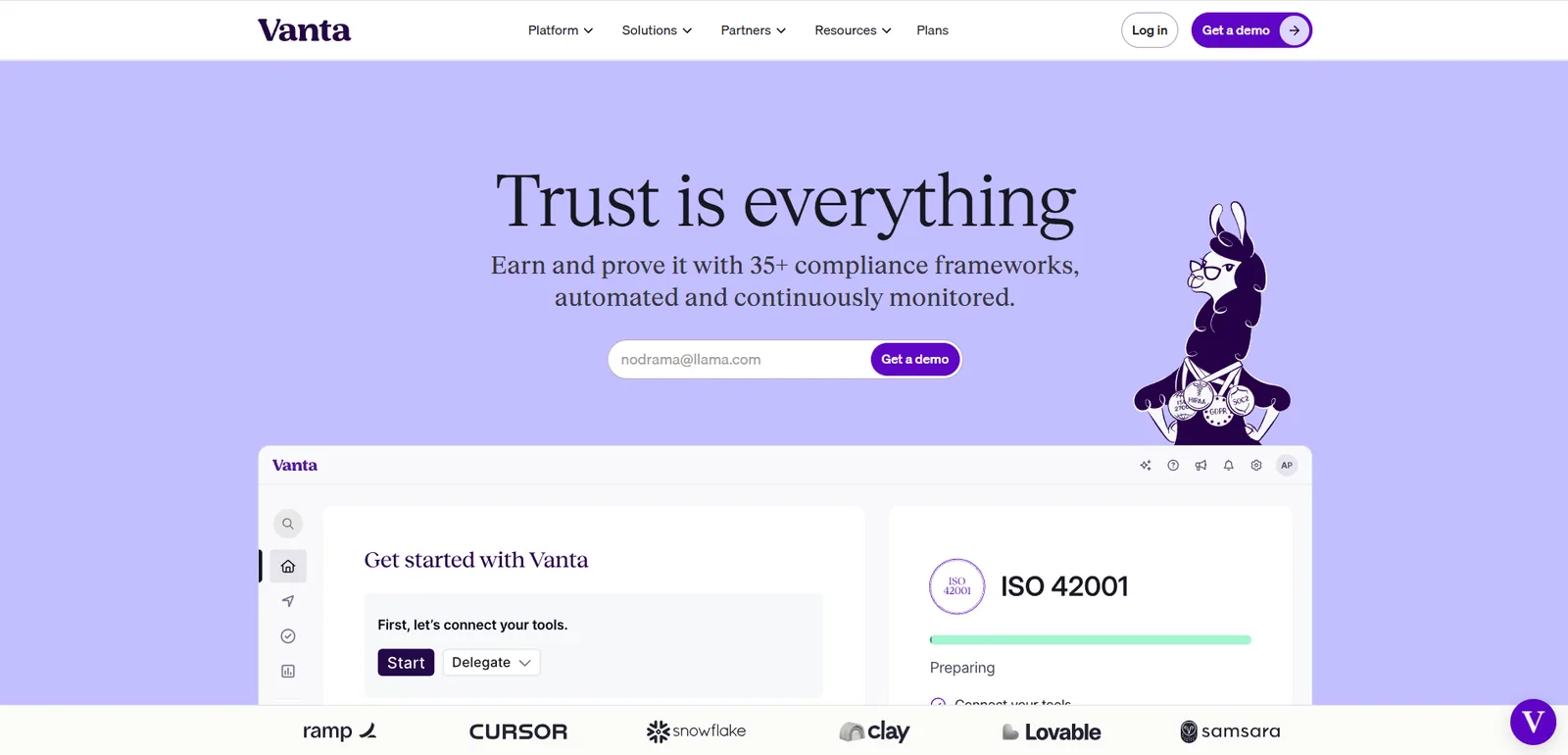
Best for: teams with an in-house GRC or security function that want software they operate themselves, with NIST CSF as one framework in a broad library.
Compliance Service Score: 7.0/10
Vanta is one of the most widely adopted compliance automation platforms in the category, with thousands of customers by its own count and the largest auditor and service partner network. NIST CSF is one framework in a broad library that also includes the NIST AI Risk Management Framework, and the platform is a system your team logs into and operates.
Product Overview
Plans are Essentials, Plus, Professional and Enterprise. Essentials covers one framework with policy generation, automated evidence collection, continuous controls monitoring and a Trust Center. Higher tiers add access management, questionnaire automation, risk management, custom tests and advanced reporting. Vanta's AI agent drafts policies, checks evidence and proposes remediation code for failing tests.
A CSF program can be extended to SOC 2 and ISO 27001 on the same platform, each priced as an additional framework.
Pricing
Vanta's own pricing page offers personalized quotes only. Its AWS Marketplace listing prices a 12-month contract for 1 to 20 employees at $14,000 for Essentials, $21,500 for Plus and $23,000 for Professional, per SOC2Auditors.org (August 2026). Vendr's dataset shows annual contracts from about $7,500 to $56,781 with a $20,000 median.
Vanta prices each framework separately, with the first framework carrying the highest per-framework cost, while most of the underlying evidence overlaps.
What Stays On Your Team
Everything the platform surfaces. Vanta monitors and reports; it does not fix anything. Every failing control returns to your engineering, IT or compliance owner. Your team writes the policies from templates, operates the workflows and keeps the CSF program current.
Setup
Integrations connect quickly for cloud-native stacks and monitoring begins as soon as they are live. Program pace is set by your team's remediation.
Tradeoffs
Vanta is the right choice for a company with a GRC or security team that wants to drive its own program and use the industry's broadest partner network, with NIST CSF as one framework among several.
It is a poor fit for a company with nobody who wants to operate it, and for physical or Microsoft-heavy environments where the integration library assumes an AWS-native stack. G2 and AWS Marketplace reviews cite false positives and integration failures requiring manual override.
4. CBIZ Pivot Point Security

Best for: organizations that need a scoped NIST CSF 2.0 assessment and a roadmap from a consultancy, with vCISO hours available afterward.
Compliance Service Score: 6.9/10
Pivot Point Security, now part of CBIZ, is an information security consultancy that lists NIST CSF 2.0 among its compliance practices alongside CMMC, NIST SP 800-171, ISO 27001, SOC 2 and HITRUST. It is one of two consultancies on this list, and the one whose model differs most from the platforms: it assesses and advises rather than providing a system.
Service Overview
Per its own site, Pivot Point offers gap assessments against NIST CSF 2.0, internal audit, virtual CISO services, vendor due diligence, penetration testing and security awareness education. A CSF engagement typically produces a scored assessment across the six Functions and a prioritized roadmap, with vCISO hours available to help the customer execute it.
Pricing
Quote only, scoped by engagement. CBIZ Pivot Point Security publishes no rates. Ask what the assessment costs, what the roadmap deliverable contains, and how vCISO hours are priced if you want help executing it.
What Stays On Your Team
Remediation and program operation between assessments, unless vCISO hours are scoped to cover them. The consultancy scores and advises; your team closes the gaps and keeps the score current until the next engagement.
Setup
Sales-led scoping, then interviews, documentation review and a scored report. Timeline depends on scope and your team's availability for interviews.
Tradeoffs
CBIZ Pivot Point Security is the right choice for an organization that needs a defensible one-time score and a roadmap, especially where CMMC or NIST SP 800-171 sits alongside CSF. The model is advisory: the work between assessments is yours, the score is a point in time, and re-assessment is a new engagement.
Confirm the current NIST CSF service scope and pricing model directly, because the published detail is thinner than for the platforms on this list.
5. Drata
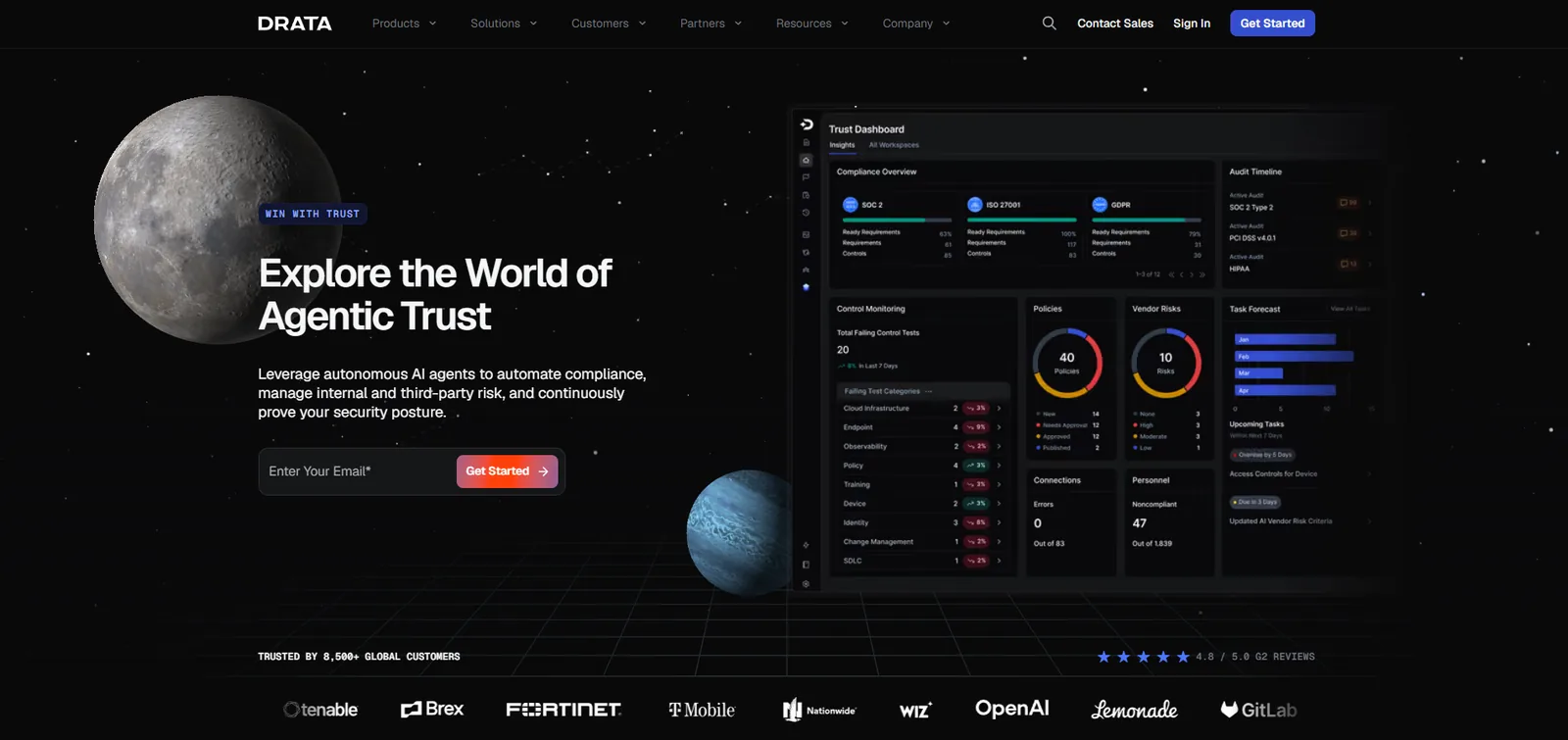
Best for: engineering-led teams that want software they operate themselves and treat compliance as code, with NIST CSF 2.0 activated alongside SOC 2.
Compliance Service Score: 6.9/10
Drata is a compliance automation platform positioned for engineering-led teams. Its help center documents NIST CSF 2.0 as a framework customers activate from the frameworks page, with automatic access for anyone who bought CSF 1.1. Like Vanta, it is operated by the customer.
Product Overview
Plans are Foundation, Essential, Advanced and Enterprise. The platform monitors controls continuously, maps evidence to multiple frameworks, provides a policy center with templates, and gives assessors a dedicated workspace. The Drata Trust Center, built on its SafeBase acquisition, handles security reviews and questionnaires. NIST CSF 2.0 runs alongside SOC 2, ISO 27001, HIPAA, GDPR and PCI DSS, with custom frameworks on higher tiers.
Pricing
Quote only, with no free tier and a one-year minimum commitment. Reported medians differ by dataset: Orbiq cites a Vendr median of about $24,600 per year across 222 tracked purchases, while UnderDefense cites a median near $38,000 across 94 verified purchases. Third-party guides report Foundation plans starting around $7,500 and Enterprise contracts exceeding $100,000. Per-framework fees and implementation sit outside the platform number.
What Stays On Your Team
Everything the platform flags. Drata monitors and reports; remediation, policy work and keeping the CSF score current remain with your team. The platform is a faster dashboard, and the answer is only as current as the last time somebody checked.
Setup
Cloud, identity and HR systems connect through the integration library, with monitoring beginning once they are live. Program timelines are set by your team's remediation pace.
Tradeoffs
Drata is a strong choice for a company with engineers who want to treat compliance as code and a team to run it, and for running CSF and SOC 2 on one platform. It is quote-gated at every tier, carries hidden costs that third-party analysts estimate at 20 to 81 percent over the base license, and offers no committed date. Buyers with Microsoft-heavy or physical environments should confirm integration coverage before signing.
6. BSI

Best for: organizations that want a framework-agnostic maturity assessment against NIST CSF 2.0 from a globally recognized name, with current and target maturity levels set in workshops.
Compliance Service Score: 6.8/10
BSI's consulting practice offers a NIST cyber posture maturity assessment against NIST CSF 2.0, NIST SP 800-53 and NIS 2, described on its own service pages. It is the framework-agnostic option on this list: the same practice assesses against ISO 27001, and BSI's separate certification arm is one of the most recognized names on ISO certificates worldwide.
Service Overview
Per BSI, the assessment runs as facilitated threat workshops to understand the business, identification and assessment of critical assets and threats, an evaluation of the organization's ability to defend and recover, alignment to the chosen framework with expected, current and target maturity levels, an assessment of framework controls against those levels, and risk mitigation guidance to reach the target. The output is a maturity picture and a roadmap.
Pricing
Quote only, scoped by engagement. BSI publishes no rates for the maturity assessment. Ask what the workshops, the assessment and the roadmap cost separately, and what a re-assessment costs in year two.
What Stays On Your Team
Remediation and program operation after the assessment. BSI sets the maturity levels with you and tells you what to fix; your team fixes it and keeps the program current until the next engagement.
Setup
Workshop-led, scheduled against your team's availability. Ask how many workshops are scoped and who needs to attend from your side.
Tradeoffs
BSI is the right choice when the board wants a maturity number from a name it recognizes, when NIST CSF sits alongside ISO 27001 or NIS 2, and when a workshop-based methodology suits how your organization makes decisions.
The model is assessment and roadmap: the work is yours, the score is a point in time, and re-assessment is a new engagement. There is no committed date.
7. CyberSaint
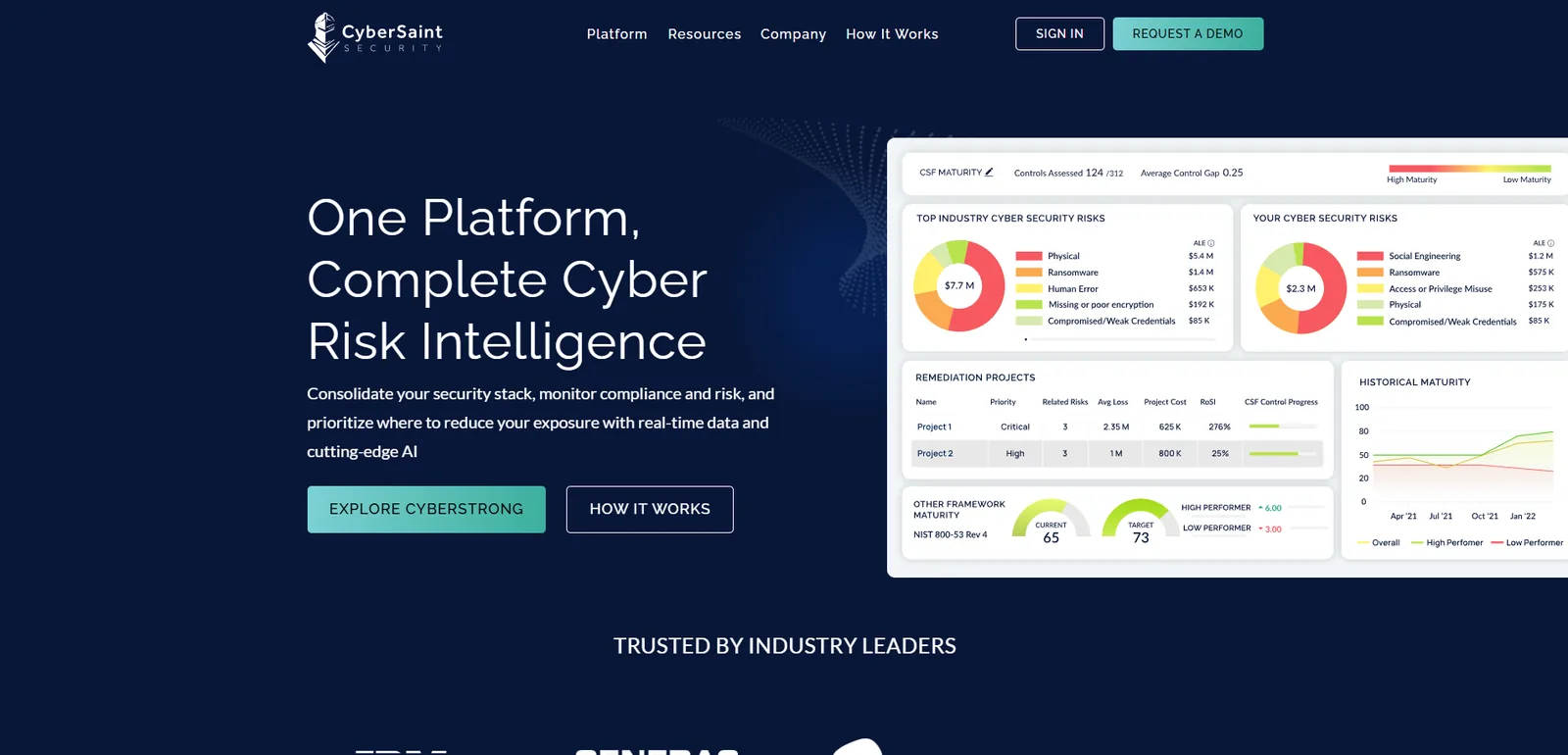
Best for: large enterprises with a NIST-focused risk program that want Tier scoring, crosswalks and cyber risk quantification in one platform their team operates.
Compliance Service Score: 6.8/10
CyberSaint's CyberStrong platform is built around NIST: it publishes NIST CSF 2.0 as a reference framework with a Tier 1 to 4 scoring model, crosswalks to CSF 1.1 and NIST SP 800-53, and quantifies cyber risk for board reporting.
Its own materials position it for critical infrastructure, manufacturing, utilities, financial services and insurance enterprises that want credible standardization on frameworks and easy reporting up the chain.
Product Overview
CyberStrong is organized into a Compliance Hub, a Risk Hub and an Executive Hub. The Compliance Hub covers industry risk benchmarking, a framework and controls library, automated crosswalking, unlimited assessments and a governance dashboard, with Continuous Control Automation as an add-on. The CSF 2.0 scoring model uses the framework's Implementation Tiers: Partial, Risk-Informed, Repeatable and Adaptive. More than 60 frameworks are built in.
Pricing
Quote only at every tier. Capterra lists a flat-rate pricing model with multi-year discounts, monthly pricing and a free trial; ToolRadar records all three hubs as "contact us." A July 2026 Copla review positions CyberSaint for large enterprises with NIST-focused risk programs and notes it may be excessive for smaller teams.
What Stays On Your Team
Configuring and operating the platform, running the assessments, closing the gaps and collecting the evidence. CyberStrong scores and reports; the work behind the score is yours.
Setup
Sales-led, with a demo. Configuration depth depends on how many frameworks and risk models you switch on.
Tradeoffs
CyberSaint is the strongest NIST-native scoring platform on this list and the natural choice for a large enterprise that wants Tier scoring and cyber risk quantification in one place. The same Copla review notes a limited public review base across G2 and Gartner Peer Insights, and the model is built for a risk team that will operate it.
For a regulated mid-market company with nobody to run it, the scoring is only as current as the last assessment someone remembered to run.
8. Apptega
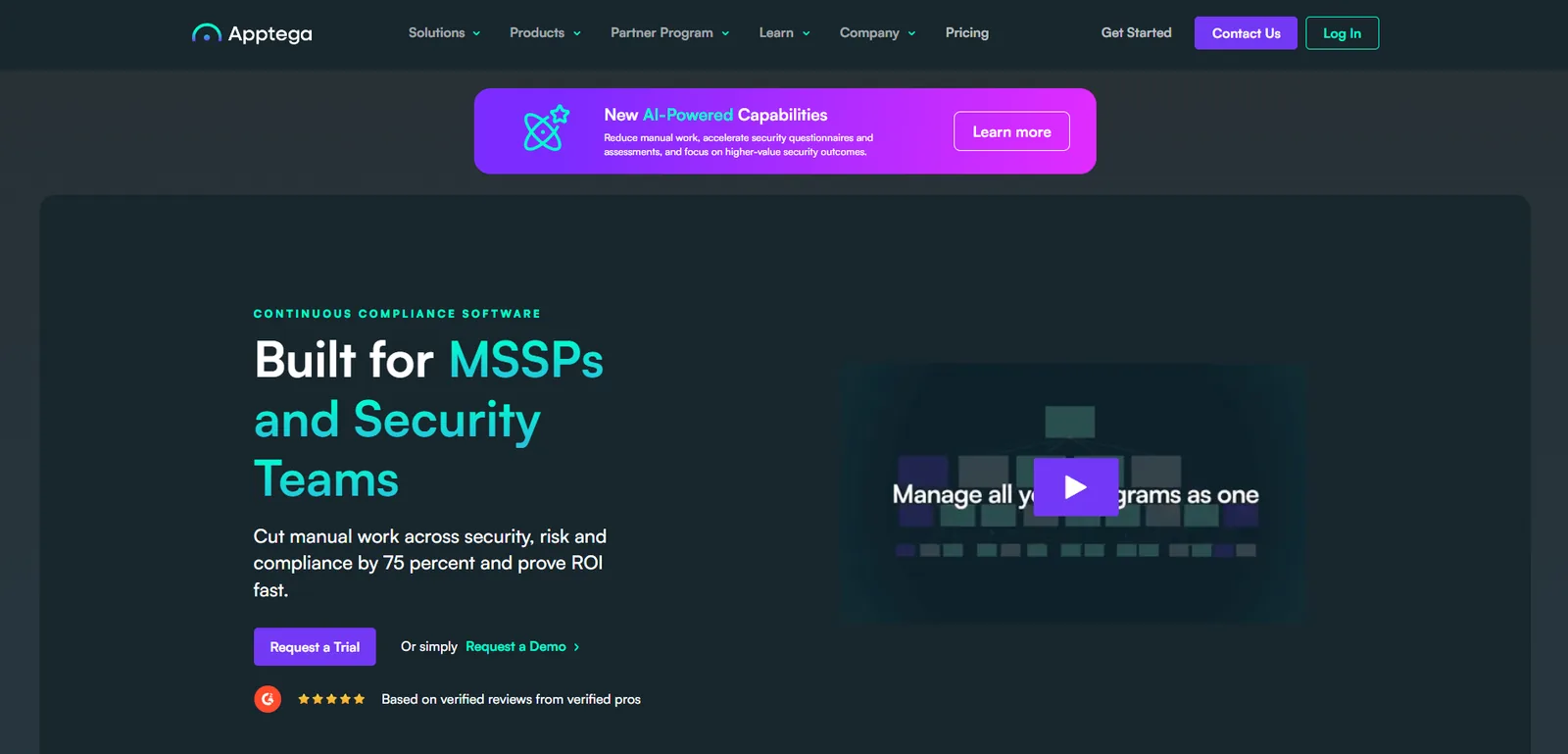
Best for: organizations whose managed service provider will run the program, or teams that want a control-by-control CSF tracker with a published starting price.
Compliance Service Score: 6.4/10
Apptega is a compliance program platform that tracks NIST CSF control by control, assigns tasks and due dates, rates risk, and reports on progress. It publishes a starting price, which almost nobody in this category does, and it is widely used by managed service providers and consultants to run programs across multiple client organizations.
Product Overview
Apptega evaluates current status against each CSF control and subcontrol, assigns tasks and owners, scores risk to support a risk-based approach, and produces reports for leadership. Frameworks include NIST CSF, CMMC, SOC 2, ISO 27001 and HIPAA. The multi-tenant model is what makes it a common choice for MSPs delivering compliance as a service.
Pricing
Software Advice lists a starting price of $9,950 per year with a free trial available, which makes Apptega one of the few providers on this list with a published entry figure. Program pricing above that is quoted, and if an MSP runs the platform for you, the MSP's service fee is separate.
What Stays On Your Team
If you buy Apptega directly: configuring the platform, running the assessment, remediating the gaps and keeping the score current. If an MSP runs it for you, that split moves to the MSP contract, and you should confirm exactly what the MSP performs versus what you do.
Setup
Self-directed or MSP-led. Ask whether you are buying the platform or a partner's service built on it, because the answer changes who does the work.
Tradeoffs
Apptega is the right fit for an organization whose MSP will run the program, or for a team that wants a straightforward CSF tracker with a price it can see. Buyers evaluating Apptega directly should confirm whether they are buying the platform or a partner's service, since the two look identical in a demo and very different in month three.
Continuous evidence collection is not the platform's center of gravity, so the score depends on the operator's discipline.
9. LogicGate
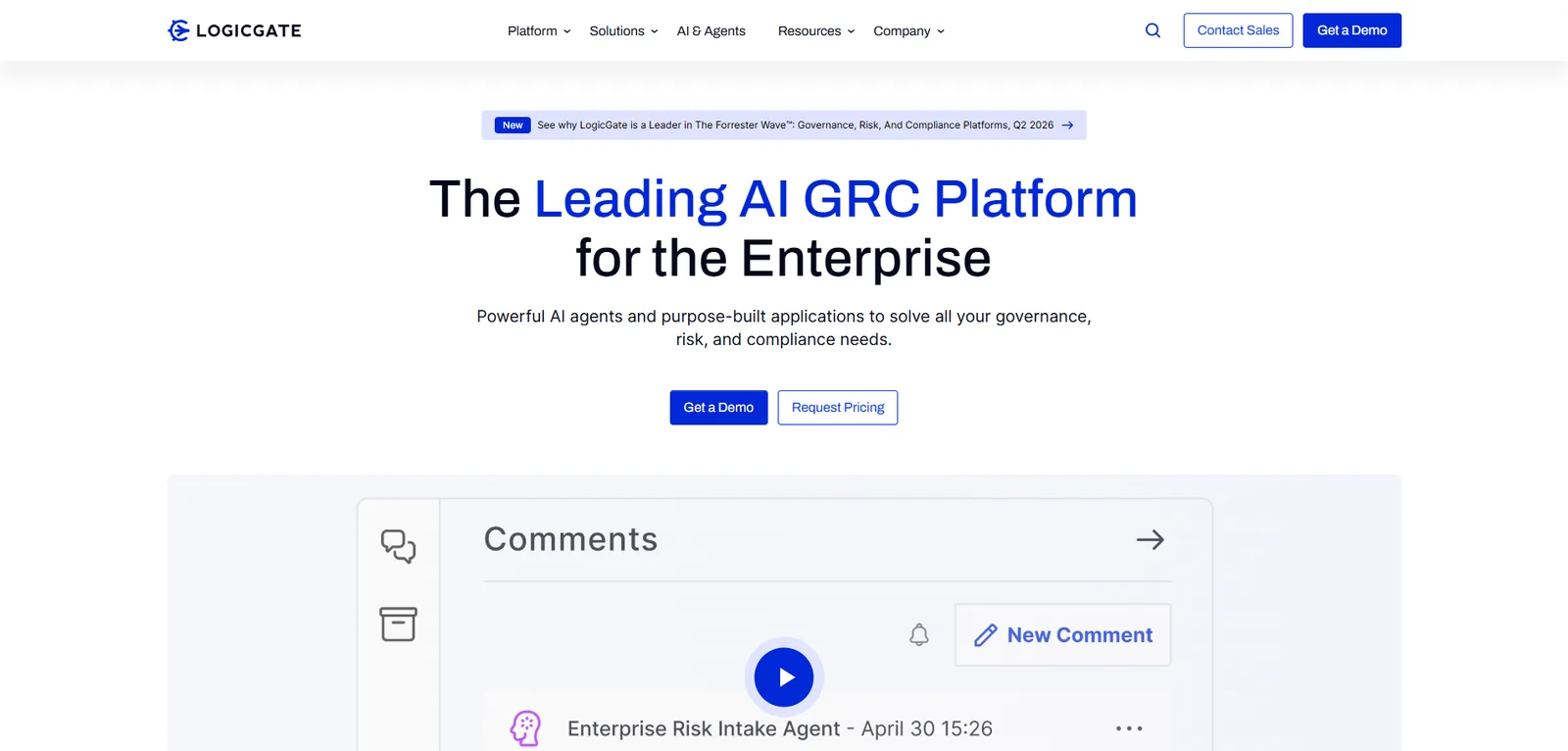
Best for: GRC teams with the time and background to build their own risk and control workflows on a no-code platform.
Compliance Service Score: 5.9/10
LogicGate's Risk Cloud is a no-code platform for building risk and control workflows, with pre-made templates, custom reports, dashboards and heatmaps. NIST CSF runs as one of many configurable applications, and the platform is built to be shaped by the customer's own GRC team.
Product Overview
Risk Cloud provides a visual workflow builder, a risk register, control mapping, and reporting that a GRC team configures to its own process. A 2026 ComplyJet review describes it as the most customizable platform in its evaluation. It integrates with enterprise systems through APIs, and NIST CSF is handled through templates the customer adapts.
Pricing
Custom quote only, with no free trial and no free version, per Capterra and Software Advice. Third-party pricing trackers record a single "request custom pricing" tier. Ask how pricing scales with applications and users.
What Stays On Your Team
Everything. Risk Cloud is a platform for building your own program: your team designs the workflows, configures the CSF application, runs the assessments, closes the gaps and maintains the reporting. The flexibility is the point, and the work is the price of it.
Setup
Implementation-led. The same ComplyJet review cites lengthy implementation and a steep learning curve for teams without a GRC background.
Tradeoffs
LogicGate is the right choice for a GRC team that wants to model its own risk and control processes and has the time to build them.
The 2026 ComplyJet review that calls it the most customizable platform also calls it the hardest to adopt, citing lengthy implementation, a steep learning curve without a GRC background, and the fewest native integrations among the platforms it reviewed. For a company with nobody to run it, that is the wrong tool.
How We Built This Guide
We started with the situations that bring people to this search. A customer, a cyber insurer or the board has asked which framework the security program follows. A federal, state or sector contract names NIST CSF or an adjacent NIST publication. Leadership wants a maturity number it can track across the six Functions instead of a narrative update.
The one person who ran the program has left. A certifiable framework is coming next and nobody wants the CSF work redone.
Every one of those reduces to the same question: after the assessment, who does the work, how does the score stay true, and what happens when a customer asks for a certificate? So we organized every provider entry around the same axis. What the provider does for you. What stays on your team.
Who stands behind the score and keeps it true. We applied that axis to EasyAudit as rigorously as to everyone else.
We then read each provider's own service pages, help documentation and pricing pages in September 2026, checked marketplace and review-site listings where they exist, and used third-party transaction datasets and published 2026 reviews only for observed pricing ranges and recurring patterns, attributed inline.
Where a claim could not be sourced to the provider's own material or a named dataset, we left it out or turned it into a question for you to ask that provider. Providers whose NIST CSF service we could not confirm from their own material are not on this page.
How To Choose a NIST CSF Compliance Service
Six steps, each specific enough to run this week.
Step 1: Separate What the Provider Does From What Your Team Does
Ask every provider for a written split of responsibilities: who maps your controls to the 106 subcategories, who writes the policies, who remediates a gap, who collects evidence the integrations cannot reach, and who re-scores the program when the environment changes. Then ask how many hours per week your team should expect in month two.
A platform vendor will describe monitoring. A consultancy will describe an assessment. Neither answer is the program. If the answer to "who fixes it" is your engineer, budget the engineer.
Step 2: Decide Whether You Need a Score, a Program, or a Certifiable Framework
Three different purchases hide behind the same search. A score is a one-time assessment for a board or an insurer, and a consultancy sells it well. A program is a maintained set of controls and evidence that stays true between assessments, and it needs an operator: your team, a platform, or a service.
A certifiable framework is what a customer means when they stop accepting a self-scored CSF and ask for SOC 2 or ISO 27001. Decide which one you are buying now and which one is coming within 24 months, because the second answer should drive the choice.
Step 3: Confirm How Maturity Tiers and Profiles Are Scored
NIST CSF 2.0 gives you the vocabulary: six Functions, Implementation Tiers from Partial to Adaptive, and Current and Target Profiles. It does not give you a scoring method, so every provider has its own. Ask each one what a score is built from: a questionnaire your team fills in, interviews and document review, or evidence verified in your systems.
Ask whether the Current Profile is produced from what is actually in place, who sets the Target Profile, and how often the score is refreshed after the engagement. A score built from a questionnaire is an opinion. A score built from verified evidence is proof.
Step 4: Check Whether the CSF Work Carries Into SOC 2 or ISO 27001
Write down the certifiable framework a customer is most likely to ask for within two years. Then ask each provider whether the controls and evidence from the CSF program carry into it, and what percentage. Most price each framework separately while the evidence overlaps 60 to 80 percent.
One control library that satisfies up to seven frameworks means the CSF program is the foundation, not a detour. If the provider cannot answer the percentage question, the second framework is a new project.
Step 5: Price the Whole Program, Not the Assessment
NIST CSF carries no certification body fee, which makes the assessment look cheap and the program look free. It is neither. Add the re-assessment cost each year, the platform operation, the per-framework fee when a certifiable framework follows, and the internal line: the hours your team spends between assessments keeping the score true.
Consultants and human-centric tools cost ten to a hundred times more manual hours than a service that performs the work. Compare the recurring total, not the assessment quote.
Step 6: Test the Provider Against Your Actual Environment
Name your systems before the demo: Microsoft 365, Entra ID, Intune, Azure, on-prem Active Directory, the badge system on the data center floor, the call recording platform, the FDA-regulated manufacturing line. Ask the provider to show evidence collection from each one, not from a demo AWS account. Ask what happens when there is no integration.
A provider built for cloud-native SaaS will either say "screenshots" or go quiet. A provider built for regulated operations will tell you whether its expert comes to the facility, which for the Protect and Detect Functions in a physical environment is not a courtesy.
NIST CSF Compliance Services Pricing and Costs in 2026
Three cost models appear among NIST compliance companies. Unlike SOC 2 or ISO 27001, there is no certification body fee, because there is no certificate. The recurring cost is in maintaining the program and keeping the score true, not in an annual audit.
Quote-only platform subscriptions. Vanta, Drata, Secureframe, CyberSaint and LogicGate publish entry SKUs on marketplaces or nothing at all; Apptega is the exception with a listed starting price of $9,950 per year.
Observed contracts for the general compliance platforms run from about $7,500 to more than $100,000 a year depending on headcount and framework count, with medians reported by Vendr between roughly $20,000 and $38,000 (Vanta, Secureframe, Drata). Each additional framework is priced separately, so the CSF-to-SOC 2 step is a new line.
Third-party analysts estimate hidden costs at 20 to 81 percent over the base license. The internal cost is the largest line and never appears on the quote: every gap returns to your team.
Consultancies billing by scope for an assessment. CBIZ Pivot Point Security and BSI's consulting practice scope engagements individually and publish no rates. Third-party guides put an external framework readiness assessment at $10,000 to $40,000 depending on size, with consultant time at $150 to $300 an hour for remediation help. The assessment tells you where you stand today.
Keeping it true is billed as a new engagement or done by your team.
Outcome-priced service. EasyAudit runs the free Compliance Simulation on your own environment first, then fixes the investment and the timeline at signature. Because NIST CSF has no audit, the fee-at-risk guarantee attaches to the certifiable frameworks the CSF program maps into, SOC 2 and ISO 27001, with the independent auditor or certification body deciding the result.
There is no assessment charge, because the Simulation does that work for free and the report is yours either way.
The questions buyers ask about price, answered
"Can we get NIST CSF certified?" No. It is a voluntary framework with no certificate and no attestation, and any provider implying otherwise should be questioned. What you get is a scored program across the six Functions, a Target Profile you can defend, and evidence a third party will accept.
When a customer wants a certificate, SOC 2 or ISO 27001 is the answer, and a CSF program built on one control library is most of the way there.
"How long will it take and how much will it cost?" The Simulation answers both on your own data before you sign anything: readiness per framework, every material gap, the dated timeline and the investment. About 75 minutes of scheduled time across two calls.
"We already have a platform." Ask for a decision-grade analysis inside your renewal window. The Simulation shows what the incumbent leaves on your team and what a transferred program would cost, so the renewal decision is made from facts.
"We need CSF and SOC 2. Is that two projects?" With most providers, it is two price lines and most of the same evidence collected twice. With one control library, one evidence set is mapped to every framework, and the program carries 60 to 70 percent fewer controls.
"We tried a consultant or a tool before and it failed." The Simulation is a near-zero-risk diagnostic on your real environment. It costs nothing, takes about 75 minutes, and the report is yours whether or not you proceed.
NIST CSF Compliance Services Pricing Comparison
Provider | Starting Price | Model | Named expert leads | Policies written for you | Continuous monitoring | Scored across six Functions | Committed timeline with fee at risk |
EasyAudit | Fixed at signature from the free Simulation | Outcome-priced service | ✓ | ✓ | ✓ | ✓ | Dated timeline from the Simulation. Fee at risk on SOC 2 and ISO 27001 only, never on CSF. |
Secureframe | Vendr median about $20,000 per year | Subscription | Add-on | – | ✓ | ✓ | – |
Vanta | From $14,000 per year (AWS, 1 to 20 employees) | Subscription | – | – | ✓ | ✓ | – |
CBIZ Pivot Point Security | Quote only | Scoped engagement; vCISO hours optional | Add-on | Add-on | – | ✓ | – |
Drata | Vendr median about $24,600 to $38,000 per year | Subscription | – | – | ✓ | ✓ | – |
BSI | Quote only | Scoped engagement | Add-on | – | – | ✓ | – |
CyberSaint | Quote only (flat-rate model, free trial listed) | Subscription; hubs and add-ons | – | – | Add-on | ✓ | – |
Apptega | From $9,950 per year (listed) | Subscription; MSP-deliver ed option | Via MSP | Via MSP | – | ✓ | – |
LogicGate | Custom quote only | Subscription | – | – | – | ✓ | – |
Pricing as of September 2026, sourced from public marketplace and review-site listings and third-party transaction datasets as attributed in each entry. "Add-on" means the capability is available at a priced tier, through a separate practice, or through a partner. "Named expert leads" means a named person owns the engagement outcome, not a support bench. NIST CSF has no audit, so no provider, EasyAudit included, puts a fee at risk on CSF itself; EasyAudit's guarantee attaches only to the certifiable frameworks the CSF program maps into. Contact each provider directly for current terms.
Questions To Ask Before You Choose a NIST CSF Compliance Provider
Six questions. Ask every provider the same six, including us, and compare the answers side by side.
What do you perform, and what does my team perform? Get the split in writing for control mapping, policies, remediation, evidence and re-scoring, with hours per week for your team in month two.
How are maturity Tiers and Profiles scored? Questionnaire, interviews, or evidence verified in our systems? Who sets the Target Profile, and what does the Current Profile actually measure?
What happens when a control fails between assessments? Who detects it, who diagnoses it, who prescribes the fix, and who applies it. A platform detects. A service should detect, diagnose and prescribe, with a human authorizing the change.
Does the CSF work map into SOC 2, ISO 27001 or NIST SP 800-171? Ask for the percentage of controls and evidence that carry over. If the provider cannot answer, the certifiable framework is a new project.
How often is the score refreshed? Annually on re-engagement, when your team remembers, or continuously as evidence changes? A customer or insurer will ask for the evidence behind the number, not the number.
What does the program cost after year one? Re-assessment fees, platform renewal, per-framework fees when a certificate follows, and the year-two price in the contract. Reviews across this category report renewal increases from 5 to 40 percent.
What To Verify Before You Sign
These purchases fail quietly, because nothing forces the issue. There is no audit date, so the buyer discovers in month nine that the score has not been touched since the assessment, that the Azure integration returns errors, or that the evidence behind the board's number is a spreadsheet nobody can source.
Then a customer asks for SOC 2 and the work starts over. Verification is how you find those problems while you can still walk away.
Critical checks:
The written responsibility split from Step 1, signed by the provider, with named owners on their side for control mapping, policies, remediation, evidence and re-scoring.
The scoring methodology in writing: what the Current Profile is built from, who sets the Target Profile, how Implementation Tiers are assigned, and how often the score refreshes.
A sample policy the provider has produced for a company like yours, read by your legal or compliance lead for whether it describes your environment or a generic one.
The audit trail: every approval shows who and when, the trail is enforced below the application layer so it cannot be bypassed, and retention covers the years a customer or insurer will ask about. Database-level trails with 7-year retention exist in this category; ask for the equivalent.
Read-only access for an assessor, insurer or customer reviewer, with a demonstration that they can view but not alter or approve anything.
The carry-over into SOC 2 or ISO 27001, stated as a percentage of controls and evidence, and the per-framework price, in the contract, not the deck.
Name specific systems to test during evaluation: your identity provider (Entra ID or Okta), your endpoint manager (Intune or Jamf), Microsoft 365 Purview or Google Workspace, your cloud accounts, your HR system, your ticketing system, and anything physical that a Protect or Detect control touches: badge access, visitor logs, camera retention, call recording.
Ask for evidence collected from each one during the trial or the Simulation, not from a demo tenant.
Key Capabilities to Look for in a NIST CSF Compliance Service
1. Subcategory-Level Assessment Across All Six Functions
If the provider scores you at the Function or Category level, the number is too coarse to act on and too coarse to defend. Look for control mapping to every one of the 106 CSF 2.0 subcategories, including the Govern Function added in 2.0, so a gap is a specific control with a specific owner and a specific fix. Ask to see the mapping, not the dashboard.
2. Current and Target Profile Scoring Built From Verified Evidence
If your Current Profile comes from a questionnaire, it measures what your team believes, not what is in place. Look for a Current Profile built from evidence verified in your connected systems, a Target Profile you set and approve, and a stated gap between them that translates into work with a timeline. Ask how the score changes when the environment changes.
3. Continuous Evidence Between Assessments
If the score is refreshed once a year, it is wrong for eleven months. Look for monitoring that checks controls daily against your connected systems, detects drift the day it appears, diagnoses the cause and prescribes the fix. Ask how many checks run, across which providers, and whether the monitoring is read-only. Nothing stays correct on its own.
4. Carry-Over Into Certifiable Frameworks
If the CSF program is a dead end, the day a customer asks for SOC 2 you start again. Look for one control library that every framework maps into, so a CSF control satisfies SOC 2, ISO 27001 and NIST SP 800-171 wherever they ask for it, and one evidence set covers all mappings.
The practical test is a number: ask what percentage fewer controls you will carry running CSF and SOC 2 together versus separately. In EasyAudit's program the answer is 60 to 70 percent.
5. Named Human Accountability
If nobody at the provider is accountable for your program, your program is your problem. Look for a named expert who owns the engagement, checks every piece of work, presents the score to whoever asked for it, and answers to a timeline. A support bench answers questions. An accountable person owns results.
Ask who that person is before you sign and how often you will hear from them.
6. Evidence a Third Party Will Accept
If a customer's security reviewer or a cyber insurer rejects your evidence, the score was worth nothing. Look for approvals recorded with who and when, a trail enforced at the database level so the application cannot bypass it, evidence traceable to its source system rather than to a screenshot, and read-only access for whoever is checking. The question every architectural choice should answer: would an auditor trust this?
Which NIST CSF Compliance Service Is Right for Your Organization?
If you have a GRC or security team that wants to operate the program itself, the NIST CSF assessment platforms to shortlist depend on depth: CyberSaint for Tier scoring and cyber risk quantification at enterprise scale, LogicGate if your team wants to build its own workflows, Vanta or Drata if CSF is one framework among several and SOC 2 is on the same roadmap, Secureframe if you want an expert bench inside the subscription.
If you need a one-time score and a roadmap for a board or an insurer, choose a consultancy: CBIZ Pivot Point Security where CMMC or NIST SP 800-171 sits alongside CSF, BSI where the board wants a globally recognized name and a workshop-based methodology.
If your managed service provider will run the program for you, ask them whether they run it on Apptega, and confirm exactly what they perform versus what you do.
If you are a regulated company, someone is asking which framework you follow, nobody internal wants to own the program, a certifiable framework is coming within two years, and your environment includes Microsoft, on-prem or physical operations, choose the provider that performs the work, keeps the evidence current and carries the program into SOC 2 or ISO 27001. That is EasyAudit. Request a Demo and decide from your own numbers.
Is EasyAudit Worth Its Cost?
Against a one-time assessment, no. If your board wants a number once and nobody will ask for the evidence behind it, a consultancy engagement is the rational purchase, and EasyAudit sends that buyer to one.
Against what a maintained framework program costs a regulated company, the comparison changes. Add the re-assessment each year. Add the platform your team operates between them, and the hours your engineers spend closing gaps a dashboard flagged.
Add the SOC 2 or ISO 27001 project that starts from scratch when a customer stops accepting a self-scored CSF, and the deal that waits while it does. Consultants and human-centric tools cost ten to a hundred times more manual hours than Autonomous Compliance, and none of them keeps the score true between engagements.
EasyAudit is the right purchase when the program is what you are buying and the operating of it is what you want to stop doing. The Simulation exists so you can check that on your own environment before spending a dollar. Compliance runs on someone's time. We changed whose.
"It's only a matter of time before someone says, 'You need this to move forward.'" Adam Bouchard, Co-Founder, Alignd, EasyAudit customer.
FAQs
Is there such a thing as NIST CSF certification?
No. NIST CSF is a voluntary framework with no certificate, no attestation and no pass; question any provider implying otherwise. What you can produce is a scored program across the six Functions, a defensible Target Profile, and evidence a third party will accept. For a certificate, the answer is SOC 2 or ISO 27001.
What is the difference between a NIST CSF compliance service and an assessment tool?
An assessment tool is a system your team configures and operates: it maps the framework and tracks gaps, and your people close them and keep the score current. A NIST CSF compliance service performs that work: controls mapped, policies written, evidence collected, gaps fixed, score maintained.
How much do NIST CSF compliance services cost?
There is no certification body fee, so the cost is the program, not an audit. Observed platform contracts run from about $7,500 to over $100,000 a year, Apptega lists a $9,950 starting price, and consultancy assessments run $10,000 to $40,000. EasyAudit fixes its price at signature after a free Simulation.
How long does a NIST CSF assessment take?
A consultancy assessment runs on interviews and document review and is scoped in weeks; a platform assessment depends on how fast your team connects systems. Both produce a point-in-time score. EasyAudit's Compliance Simulation returns readiness per framework in about 75 minutes of scheduled time, then keeps the evidence current.
Does NIST CSF work carry over to SOC 2 or ISO 27001?
Only if the provider maps controls across frameworks instead of running each as its own project. Most price frameworks separately while the evidence overlaps 60 to 80 percent. With one control library, a CSF control satisfies SOC 2 and ISO 27001 wherever they ask for it, with 60 to 70 percent fewer controls.