
Risk Appetite vs Risk Tolerance: What’s the Difference?
Ever jumped out of a plane with a parachute, confident it’ll open? That’s risk appetite. Now imagine you’re cool skydiving, but the second your backup chute has a 10% chance of failing, you cancel the jump? That’s risk tolerance.
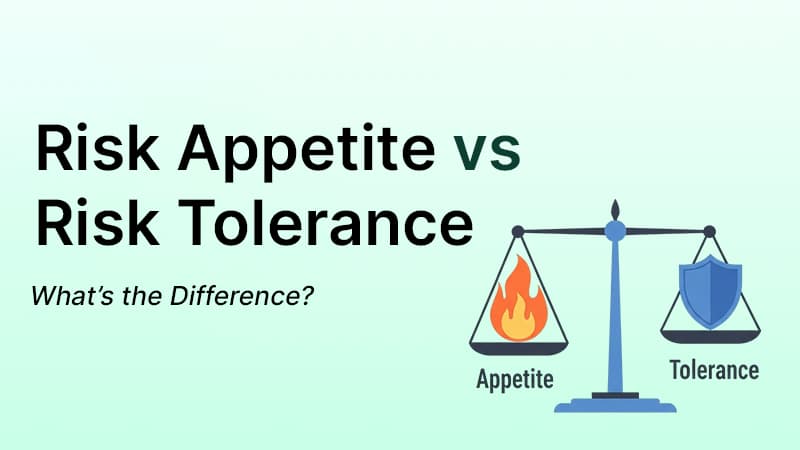
Ever jumped out of a plane with a parachute, confident it’ll open? That’s risk appetite. Now imagine you’re cool skydiving, but the second your backup chute has a 10% chance of failing, you cancel the jump? That’s risk tolerance.
Both are about risk. But one’s your willingness to engage. The other’s your limit for how much of a mess you can tolerate if things go south.
Yet businesses confuse the two constantly, and that confusion can cost millions. Just look at this way, the average cost of just a data breach has increased by 10% across industries in the last year alone.
Many of the most expensive incidents aren’t due to a lack of effort. They were caused by unclear thresholds. Someone somewhere had an appetite for innovation but no tolerance for disruption. Or vice versa. That leads to breaches, fines, and PR hell.
So what do risk appetite and risk tolerance actually mean in practice? How do you define them clearly (and use them to satisfy auditors instead of panicking when they call)?
“Every risk you don’t define is a risk you’re already taking. Appetite and tolerance are how you get out in front instead of playing cleanup.” - Christian Khoury, CEO of EasyAudit.
Risk Appetite vs Risk Tolerance: What is Risk Appetite?
Risk appetite isn’t about going out and looking for trouble. It’s more about accepting that every step forward towards growth and innovation comes with some risk – and knowing what you’re willing to handle. At its core, risk appetite is the amount of risk your organization is willing to accept in pursuit of your goals.
Think of it as your business’s flavor of boldness. Are you okay investing in bleeding-edge tech that might blow up (in a good way)? Or do you break into hives if someone installs a Chrome extension without a six-month security review?
Your risk appetite defines:
How aggressive you are with innovation
What kinds of initiatives you pursue
How much uncertainty you're comfortable with
It’s not about how much risk you can handle (that’s tolerance). It’s how much you want to take on.
Appetite: Not Arrogance
Let’s ground this in reality:
A FinTech startup might have a high risk appetite for market expansion, launching new features before regulation catches up.
A hospital system under HIPAA probably has a low appetite for anything that touches patient data without a decade of audits.
Risk appetite varies by industry, leadership, and regulatory environment. A defense contractor chasing CMMC Level 2 won’t take random risks. One wrong move and it’s “bye-bye billion-dollar contract.”
Having a high risk appetite doesn’t mean you’re careless. It means you’re making calculated bets. The keyword is alignment: between risk appetite and your strategic objectives.
“Risk appetite is your green light. Just make sure your brakes (a.k.a. risk controls) work.” -, EasyAudit. Looking at it from a framework perspective:
ISO 27001: Risk appetite guides your ISMS scope and control prioritization.
CMMC: Appetite informs which level you shoot for: Level 1 vs Level 3.
GDPR: Even if you’re okay with marketing risks, a low appetite for personal data leaks is non-negotiable.
Risk Tolerance vs Risk Appetite: What is Risk Tolerance?
If risk appetite is your hunger level, risk tolerance is your allergy list. You're willing to eat spicy food, but if it makes your lips numb for two days, that’s over the line.
Risk tolerance is the acceptable deviation from your objectives, the “how much is too much?” question. It’s not about what you want, it’s about what you’ll still survive operationally.
Here’s an example: Your company might be happy to expand into a new, volatile market (high appetite). But if your customer churn spikes more than 5% in a quarter? Game over. You’ve exceeded your tolerance – and everything gets revised.
Risk tolerance is quantifiable. It’s:
A percentage of uptime you’re willing to risk
A budget variance you’ll accept
A number of failed logins before triggering account lockout
And in regulated industries, your tolerance is often set for you.
HIPAA doesn’t care if your startup is moving fast. If you can’t tolerate ePHI exposure, you’ll pay fines that will shut you down.
CMMC has near-zero tolerance for unlogged access to sensitive systems.
GDPR tolerance? Let’s just say the EU Commission has no grey areas regarding data privacy and security standards.
Tolerance drives:
Control strength: If your tolerance for outages is low, you need redundancy.
Alerting thresholds: How early you want to know something’s breaking.
Board decisions: Investors want to see how much pain you’re willing to accept before pulling the plug.
Risk Appetite vs Risk Tolerance: Key Differences
These two terms get thrown around like synonyms at compliance meetings, but they’re not interchangeable. If risk appetite is your willingness to climb the mountain, risk tolerance is the part where you say, “but not in a blizzard.”
“Appetite says: ‘We’re aiming for growth.’ Tolerance says: ‘Just don’t tank the business doing it.’” - EasyAudit Advisory Board Member
Let’s break it down in real-life compliance terms:
GDPR: You might appetite risky marketing tactics, but tolerance for violating consent rules? Essentially zero.
ISO 27001: Appetite drives the scope of your ISMS. Tolerance tells you which risks need immediate mitigation.
HIPAA: Appetite might include launching a new mobile health app. Tolerance is your zero-room-for-error stance on patient data security.
Risk Appetite vs Risk Tolerance Example
Imagine you’re a SaaS company developing a new product for the healthcare market, which means you’re now swimming in HIPAA territory.
The Appetite:
You’re aiming to break into a lucrative, high-regulation market. Your risk appetite is high, and you’re willing to bet on rapid product development, compliance investment, and aggressive timelines.
You say:
“We’re okay pushing our roadmap hard and taking on regulatory complexity. The prize is worth it.”
The Tolerance:
Now comes the reality check.
You can’t tolerate more than 0.01% data loss: HIPAA won’t allow it.
You won’t risk more than two customer-reported privacy complaints per year.
Your investors have zero tolerance for fines or being featured on the OCR’s Wall of Shame.
So, while you’re all in strategically, your tolerance for things actually going sideways is very narrow.
You need:
End-to-end encryption
Real-time monitoring
Bulletproof logging
A comprehensive compliance team
Top: “Enter healthcare market?”
Middle: Appetite = YES, high investment → Timeline, budget, resourcing
Bottom: Tolerance = LOW for data loss, reputational risk → Triggers strict controls
This is the sweet spot where EasyAudit thrives. It lets you define both appetite and tolerance in your control dashboard, tracks real-world events against thresholds, and alerts you before you ever hit a compliance issue.
Why These Concepts Matter in Frameworks
Every major compliance framework is secretly obsessed with risk appetite and tolerance, even if they don’t always say it outright.
ISO 27001:
This standard lives and breathes risk-based thinking. The whole point of an Information Security Management System (ISMS) is to define what matters most, based on how much risk you can afford to take.
Risk Appetite: Drives your risk assessment and treatment plan.
Risk Tolerance: Sets your risk acceptance criteria.
You literally have to document what you’ll accept and why.
HIPAA:
HIPAA doesn’t ask what your appetite is; it assumes it’s “none.” But you still need to define what operational tolerances look like:
Maximum allowable downtime?
What’s a tolerable audit trail delay?
How many staff can access ePHI before it’s considered overexposed?
Too many orgs get hit with fines because they couldn’t answer these questions when HHS showed up.
GDPR:
GDPR tolerance = near zero for:
Unlawful processing
Consent confusion
Data breaches
Yet your marketing team might still have a higher appetite for A/B testing and segmentation. This is where internal misalignment can lead to external penalties.
CMMC:
CMMC is crystal clear: risk tolerance is dictated by the DoD. You don’t get to define it. But appetite still plays a role, you decide whether to go for Level 1, 2, or 3 based on how much compliance weight you’re willing to carry.
“Frameworks don’t just care what your policies say, they care whether you’re living within your tolerances. That’s where EasyAudit catches the drift before your auditor does.” - Christian Khoury, CEO at EasyAudit
“What defines appetite”
“What defines tolerance”
How to Define Risk Appetite and Risk Tolerance for Your Business
At this point, you should have a little clarity on the risk appetite vs risk tolerance confusion. The question is – how do you actually define these slippery concepts inside your company without turning every meeting into a philosophy class?
Here’s your step-by-step blueprint:
Step 1: Start With Your Objectives
What’s the business trying to do? Expand to new markets? Launch faster? Handle sensitive data? Your risk appetite needs to match the ambition.
Step 2: Run a Real Risk Assessment
Dust off that risk register (or fire up EasyAudit), and figure out:
What assets matter most?
What could go wrong?
How bad would it be?
This sets the stage for meaningful definitions.
Step 3: Involve the Right People
Risk appetite is a C-suite decision. Risk tolerance? That’s where Ops, Security, Product, and Legal step in. Get everyone in a (virtual) room and hash it out. Bonus: the auditors will love this cross-functional alignment.
Step 4: Document Both
Put it in writing. Create a statement like:
“We have a moderate risk appetite for emerging tech deployments, but a low tolerance for security incidents involving regulated data.” Share this statement with all of your team members, and make sure they’re actually on the same page.
Step 5: Monitor + Adjust
Business changes. Risk evolves. What you could tolerate at 10 employees might break you at 500. Review quarterly. Or let EasyAudit do it in real time.
“Setting risk appetite without setting tolerance is like opening a bar with no last call. Eventually, someone’s gonna get hurt.” - Advisory Board, EasyAudit
Mistakes Companies Make (and How to Avoid Them)
When it comes to risk appetite, risk tolerance, and end-to-end risk governance, most companies screw this up in at least one of these ways:
Vague definitions: If your plan is “just don’t mess up,” you’ve already messed up.
Appetite Too High, Tolerance Too Low: You want to move fast, break things, but you panic the second someone pushes to production after 5 p.m. you’ll struggle. Misalignment leads to chaos, not innovation.
Tolerance Metrics No One Tracks: “We can only tolerate 0.1% downtime,” they say. Then no one installs uptime monitors or sets alerting thresholds.
Inconsistency Across Departments: Marketing wants aggressive A/B testing. Legal says one consent failure and it’s DEFCON 1. If risk appetite isn’t shared, it becomes a liability.
Fix It With EasyAudit
The good news, the right tech makes a huge difference. With a platform like EasyAudit you can:
Define risk appetite and tolerance with built-in templates
Track real-time drift from acceptable thresholds
Centralize everything: evidence, changes, alerts - in one place
EasyAudit’s Role in Modern Risk Governance
Defining risk appetite and tolerance is great. But living within them? That’s where most orgs trip over their own policies. Here’s a closer look at how EasyAudit really helps:
Crosswalk Frameworks Automatically: One control can touch five frameworks (ISO 27001, HIPAA, CMMC, SOC 2, GDPR). EasyAudit tells you which ones align instantly.
Track Risk Tolerance in Real Time: Tired of Excel sheets no one updates? EasyAudit pulls from your cloud stack and shows where you’re in or out of bounds. If you tolerate 2 failed logins per hour and hit 3, you’ll know.
Evidence, Organized Like a Dream: Auditor asks, “Can you prove you knew your thresholds?” EasyAudit shows the log, the alerts, and the decision trail, all timestamped and ready for the experts to review.
AI-Backed, Auditor-Approved: From generating risk tolerance summaries to suggesting policy updates, EasyAudit’s AI thinks like an auditor. Only less grumpy.
Get Real About Risk Management
Let’s recap:
Risk appetite is how bold you’re willing to be.
Risk tolerance is how much failure you can handle before consequences kick in.
Every compliance framework expects you to define and live by these. But few businesses actually do. That’s the gap between checkbox security and real resilience.
EasyAudit bridges that gap. So if you’re serious about scaling, compliance, or just keeping regulators off your back, stop guessing.
Set your risk appetite. Define your tolerance. Let EasyAudit track them both, 24/7.
Book a demo today and make risk governance the easiest part of your audit strategy.
FAQs: Risk Appetite vs Risk Tolerance
What is the difference between risk appetite and risk tolerance?
Risk appetite is about how comfortable you are taking on risk to pursue goals. Risk tolerance is the operational threshold of risk you’re willing to withstand before triggering action. Think: "We’re willing to drive fast" (appetite) vs. "But not over 80 mph or the engine explodes" (tolerance).
Can you have high risk appetite and low risk tolerance?
Absolutely. In fact, most regulated industries do. A tech company may have a high appetite for new product launches, but a very low tolerance for data breaches or non-compliance, especially under HIPAA, GDPR, or CMMC.
Why are both risk appetite and risk tolerance important?
Because without them, you're flying blind. Appetite sets your growth path. Tolerance keeps you from crashing into a wall. Both help:
Align teams across departments
Guide investments in controls and tech
Avoid nasty surprises in audits
Demonstrate maturity to stakeholders and regulators
How do I define risk tolerance for compliance frameworks?
Start by identifying:
Key assets (data, systems, processes)
What could realistically go wrong
What level of risk you're operationally equipped to handle
Then document tolerances in terms of:
Downtime
Financial loss
Incident frequency
Compliance metrics
EasyAudit makes this painless by pulling in real-time data and helping set thresholds with built-in best practices.
How does EasyAudit help with managing risk appetite and tolerance?
EasyAudit lets you:
Define appetite and tolerance per business function or control
Monitor thresholds in real time with alerting
Auto-map controls across frameworks (so one fix counts twice)
Keep everything documented, audit-ready, and centralized