
ISO 27001 vs SOC 2: Which Compliance Framework Is Right for You?
Realistically, most people would rather go for a five hour hike in the rain than deal with security compliance frameworks (that’s a big reason why we created Easy Audit).
Realistically, most people would rather go for a five hour hike in the rain than deal with security compliance frameworks (that’s a big reason why we created Easy Audit). But whether you like it or not, there’s a good chance you’re going to find yourself in the middle of the ISO 27001 vs SOC 2 debate at some point. Why? Because compliance frameworks don’t just about keep auditors happy.
If you don’t have the right certifications, or at least the ability to prove you’re following the rules, you’ll miss out on some major clients, and opportunities to grow. Around 71% of businesses are asked to prove they have an ISO 27001 certification these days.
Many want to see you’re following other guidelines (like SOC 2) as well. So, how do you decide which framework to prioritize? How do you achieve compliance (and maintain it), and how do you do it all without piles of paperwork and stress?
Don’t panic. You’re not alone. We’re here to help. This guide breaks down ISO 27001 and SOC 2: what they are, how they differ, and how to choose the right one (or both).
What is ISO 27001? The Simple Answer
We already have a deep dive guide to ISO 27001 you can check out if you’re looking for detail. But if you just want a quick overview, here’s what you need to know.
ISO 27001 is the globally recognized champion of information security management systems (ISMS). It’s a framework, created by the International Organization for Standardization (ISO) and the International Electrotechnical Commission (IEC). The purpose? Making sure you have your data security act together on a global level.
Think of ISO 27001 as building a fortress. Not just walls, but watchtowers, guard dogs, a protocol for what happens if someone drops their keycard. Even a list of who’s allowed to feed the guard dogs.
Here’s what it involves:
Creating a full-blown Information Security Management System (ISMS)
Conducting risk assessments across every data-touched asset
Implementing controls from Annex A (there are 93 of them)
Surviving a two-stage external audit by an accredited body
Maintaining annual surveillance audits to stay compliant
Follow the rules, survive the audits, and you get an ISO 27001 certification – the gold standard medal currently held by more than 70,000 organizations worldwide.
“Getting ISO 27001 certified isn’t just about looking secure, it’s about actually building a culture where security is a daily habit,” says EasyAudit’s compliance team. “It’s the adulting of cybersecurity.”
The downside? It's a beast. Paperwork-heavy, audit-intensive, and, if you’re unprepared, it’s exhausting. That's why tools like EasyAudit exist: to automate the boring parts, guide you through the scope maze, and speed up certification by 2x.
What is SOC 2? An Easy Breakdown
Again, check out our full SOC 2 guide here for the deep dive, but here’s the overview.
If ISO 27001 is a fortress, SOC 2 is the digital bouncer at the club. It doesn’t just care about your policies, it wants to see if you’re actually enforcing them. It’s leaner, more flexible, and born in the USA (thanks, AICPA).
SOC 2 stands for Service Organization Control 2. It evaluates how well your systems protect customer data across five Trust Services Criteria:
Security (mandatory)
Availability
Processing Integrity
Confidentiality
Privacy
The great thing about SOC 2? You design your own control, as long as they map back to these criteria, and a licensed CPA firm audits them. There’s no formal certificate; instead, you receive a detailed SOC 2 Report that says, “Yeah, they know what they’re doing.”
There are two flavors:
SOC 2 Type I: Are the controls designed properly?
SOC 2 Type II: Do the controls actually work over time?
The latter is what enterprise buyers really want. In fact, over 70% of B2B SaaS companies now consider SOC 2 Type II a deal-critical asset for closing large accounts.
“SOC 2 isn’t just about passing an audit,” says EasyAudit’s team. “It’s about showing you can run secure operations at scale, and do it consistently.”
What companies love about SOC 2 is that it’s customizable. Fast-moving teams can tailor their controls to their stack. And platforms like EasyAudit streamline everything from readiness to audit sampling, so your DevOps lead doesn’t end up in Jira-hell exporting log files on deadline day.
ISO 27001 vs SOC 2: Key Differences Explained
We’ve met the contenders. Now let’s get to the real question: which one should your company choose? Well, that depends. Here’s the short version:
Now let’s look at the major differences in closer detail.
ISO 27001 vs SOC 2: Results of Compliance
ISO 27001 gives you a globally recognized certificate you can hang on your (virtual) wall. SOC 2 gives you a PDF report. SOC 2 isn’t technically a “certification.” It’s an attestation report from an independent auditor saying your controls are solid. It still works wonders in sales decks, particularly when it’s paired with other certificates.
In some industries, SOC 2 reports are what open deals – showing potential customers that you take security and compliance seriously. ISO 27001 certifications close those deals.
Framework Philosophy
ISO 27001 is like building a compliance factory. It’s structured, policy-heavy, and expects you to write down everything, then audit it, train on it, and review it annually.
SOC 2? More like building a reliable food truck. Just prove your hygiene, show your permits, and don’t poison anyone. You set the menu, as long as your customers don’t get sick (aka data loss), you’re golden.
Prescriptiveness vs Flexibility
ISO 27001 comes with Annex A: 93 security controls you have to consider. You document which ones apply and explain the rest in a Statement of Applicability.
SOC 2? You get the Trust Services Criteria, but you choose the controls. Want to enforce MFA using Slack emojis and Kubernetes labels? Fine, as long as it works and the auditor agrees.
Audit Structure and Cost
Typically, ISO 27001 can be less expensive. There are two audits: Stage 1 (docs), Stage 2 (everything else). Costs range from $10K–$40K, plus annual surveillance.
With SOC 2, costs depend on what type you’re going for. Type I is quick (~6 weeks), Type II takes longer (3–12 months), and costs $12K–$60K+, depending on scope.
Who Asks for What?
EU regulators and multinational enterprises? ISO 27001 or bust.
U.S.-based procurement teams? SOC 2 Type II, or you’re out.
Global SaaS startup? Eventually both.
Similarities Between ISO 27001 and SOC 2
ISO 27001 and SOC 2 are more alike than your sales and engineering teams. They share a few fundamental truths:
Risk-based thinking: Both frameworks want you to understand your risks, not just buy security tools like you’re hoarding apocalypse rations.
Continuous improvement: Neither ISO nor SOC 2 is “one and done.” They demand regular audits, updated policies, and internal reviews.
Security as a business enabler: Both frameworks are procurement gold. They reduce friction in sales cycles and say, “Yes, we take your data seriously.”
Plus, both SOC 2 AND iso 27001 encourage you to build a real culture of security and accountability. They put you on the right path for building a framework that really earns consumer trust.
When to Choose SOC 2?
Only have the resources and budget to focus on one framework right now? SOC 2 might be the top choice when:
You're a SaaS company targeting U.S. customers
You’re a startup in speed mode trying to close deals before funding runs dry
Your prospects are asking for “a SOC 2 report, please and thank you”
You want to prove trustworthiness without implementing a full-scale ISMS
It’s built for flexibility, and it scales as you grow. You don’t need to be enterprise-sized. In fact, most early-stage startups go SOC 2 first to get through vendor security reviews faster.
SOC 2 Type II can be sales rocket fuel. It shortens procurement cycles, builds buyer trust, and gives your CISO something better than a shrug when the board asks, “Are we secure?”
“Think of SOC 2 like your security resume,” says one EasyAudit customer. “Type I is your college degree. Type II is your work experience.”
The audit process can be painful without help. But EasyAudit
Automates evidence collection (no more Jira ticket archaeology)
Tracks control drift in real time
Maps controls to SOC 2 + ISO 27001 simultaneously
Prepares you for audit day like a compliance Navy SEAL

When to Choose ISO 27001
Alternatively, ISO 27001 might be the right pick when:
You’re selling into Europe or regulated industries
Your customers ask for certified compliance
You need to align with GDPR, HIPAA, or government contracts
You want to build a repeatable, audit-ready security program
It’s not just about checking boxes. It’s about building long-term trust and maturity. That means policies, controls, ownership, internal audits, and review cycles. It’s more structured than SOC 2, but also more powerful for certain use cases.
And with EasyAudit, you don’t have to choose between speed and structure. Our AI-native platform helps you:
Run lightning-fast gap analyses
Generate AI-driven risk assessments
Map real-time controls to ISO 27001 standards
Create audit-ready evidence automatically
ISO 27001 vs SOC 2 Do You Need Both?
This isn’t a cage match. ISO 27001 and SOC 2 don’t have to fight. In fact, the smartest companies use both. Here’s how the strategy usually plays out:
Start with SOC 2. It’s flexible, fast, and great for early-stage growth.
Layer in ISO 27001 when you're eyeing enterprise, international, or regulated markets.
Use one integrated compliance platform (EasyAudit) to avoid duplicating effort.
Why both? Because customers speak different security languages.
A U.S. procurement officer might say: “Where’s your SOC 2 Type II report?”
A German healthtech partner will ask: “Are you ISO 27001 certified?”
A savvy investor will ask: “Do you have a scalable compliance program?”
The good news? They overlap massively. About 70–80% of controls are common between them That’s why EasyAudit helps you:
Map controls across frameworks in one dashboard
Generate policies and audit evidence once
Track your maturity over time, not just for one audit
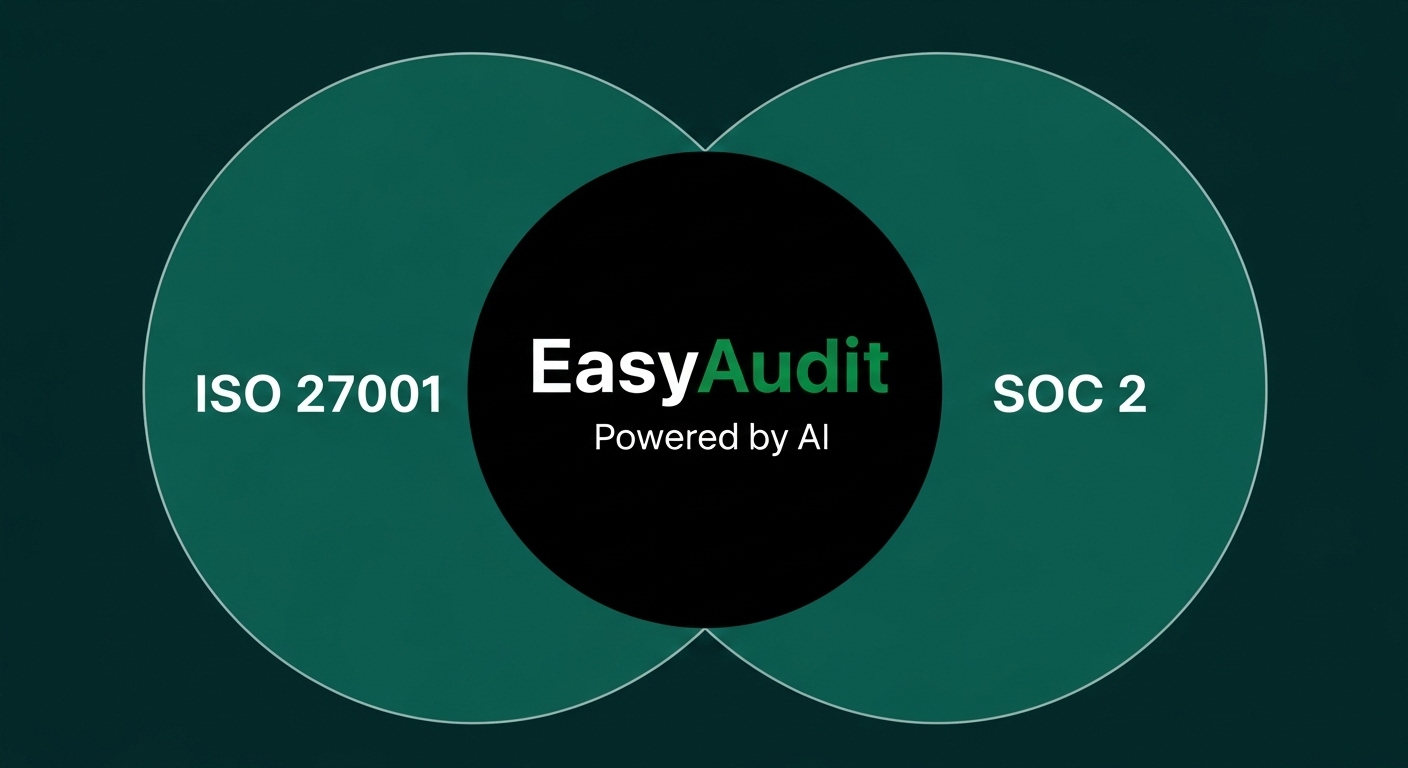
ISO 2700 vs SOC 2: Certification Process Comparison
So you’ve chosen your path. Now what? Here's how the ISO 27001 vs SOC 2 journey stacks up, side by side.
ISO 27001: The Structured Climb
Step 1: Define your scope (where the data lives)
Step 2: Run a risk assessment
Step 3: Build an ISMS (with ~93 Annex A controls to review)
Step 4: Get audited (Stage 1: docs, Stage 2: interviews & evidence)
Step 5: Celebrate, then prep for annual surveillance audits
Timeline: 3–12 monthsCost: $10K–$40K+, depending on scopeComplexity: High (but repeatable and robust)
SOC 2: The Agile Sprint
Step 1: Choose your Trust Services Criteria (Security is required)
Step 2: Design controls (you pick!)
Step 3: Gather evidence for how they’re implemented
Step 4: Audit time—choose Type I (fast) or Type II (more trusted)
Step 5: Maintain operational consistency over time
Timeline:
Type I: ~6 weeks
Type II: ~3–6 months (observation period)
Cost: $12K–$60K+ depending on breadthComplexity: Medium—but control-heavy during Type II
How EasyAudit Simplifies Compliance
Compliance is hard. It’s messy, it’s complex, and it always happens right when you’re trying to ship a release or close a deal.
Now imagine a world where:
Policies write themselves
Controls update automatically
Your auditor loves your documentation
And your team isn’t drowning in screenshots or Slack threads titled “plz find this log”
Welcome to EasyAudit.
Built by ex-auditors, engineers, and compliance renegades, EasyAudit is your AI-native co-pilot for all things ISO 27001 and SOC 2. Whether you’re just starting or juggling both frameworks, it takes the chaos and turns it into compliance Zen.
Here’s what you get:
AI-Generated Controls
Upload your tech stack, answer a few questions, and EasyAudit instantly drafts controls tailored to your actual environment, not some generic template from 2017.
Evidence Locker (Auditor-Approved)
Say goodbye to frantic PDF searches. EasyAudit captures and timestamps evidence across your infra, HR, CI/CD, and cloud accounts automatically. Your auditor will weep with joy.
Cross-Framework Mapping
Build once, comply twice. EasyAudit intelligently links your controls across ISO 27001, SOC 2, HIPAA, and even GDPR. It’s like a Rosetta Stone for risk management.
Real-Time Monitoring
Connect your stack (AWS, Okta, GitHub, etc.) and get alerts when something drifts out of compliance. Like “Oh hey, someone opened S3 to the world again.”
Audit-Ready Dashboards & Reports
Executive-friendly dashboards for leadership. Audit-ready artifacts for your CPA. No more piecing things together in PowerPoint the night before.
“We used to spend months prepping for audits. With EasyAudit, it’s mostly done before we even start,” says a Head of Security at a Series B fintech.
ISO 27001 vs SOC 2: Your Move
Choosing between ISO 27001 and SOC 2 isn’t about which is better. It’s about what works right now for your company’s goals.
Need international recognition and deep-rooted security maturity? Go ISO 27001.
Need fast trust signals and a ticket into U.S. enterprise sales? Go SOC 2.
Want both without doubling your workload? EasyAudit’s got your back.
These frameworks aren’t mutually exclusive. In fact, together, they create a security story that's both operational and strategic, one that says, “We take your data seriously, wherever you are.”
And that’s a message that closes deals, earns trust, and gets your team sleeping better at night.
So don’t pick one and panic. Pick the right path and the right platform.
Book a demo with EasyAudit today and see how you can get compliant in weeks, not months.
FAQs
What is SOC 2?
SOC 2 is a compliance framework created by the AICPA to evaluate how service providers manage customer data based on five trust principles: Security, Availability, Confidentiality, Processing Integrity, and Privacy. You don’t get a certificate, you get an audit report (Type I or II).
What is ISO 27001?
It’s a globally recognized security framework from ISO/IEC that certifies your Information Security Management System (ISMS). It requires a full risk management process, documented controls, and a multi-stage audit. It’s perfect for international trust and regulatory alignment.
What’s the difference between SOC 2 Type I and Type II?
Type I is a snapshot, are your controls in place today?
Type II is a surveillance tape, do those controls actually work over time?
Most buyers want Type II. It’s way more credible.
Can I be SOC 2 and ISO 27001 compliant at the same time?
Yes, and smart companies do. There’s about 70–80% overlap in controls. Platforms like EasyAudit make dual compliance a breeze by auto-mapping your efforts across both frameworks.
How long is a SOC 2 Type II report valid?
Generally 12 months from the end of the audit period. Let it expire, and buyers will treat you like expired yogurt. Keep it fresh.
How much do these certifications cost?
ISO 27001: $10K–$40K+ depending on size, scope, and audit body
SOC 2 Type II: $12K–$60K+, plus internal time and tooling
EasyAudit helps cut prep time by 50–70%, which also cuts consulting costs.