
Building Compliance You Can Trust: Audit Trails, Human-in-the-Loop, and Ethical AI at EasyAudit
The GRC industry has a trust problem. And it's not because of a lack of technology, but because of how that technology has been built.
The GRC industry has a trust problem. And it's not because of a lack of technology, but because of how that technology has been built.
On March18, 2026, a leaked spreadsheet revealed that a major GRC platform had generated 494 near-identical compliance reports with pre-written auditor conclusions. Board meeting minutes were fabricated. Risk assessments were offered as one-click templates. 99.8% of reports contained identical boilerplate text, right down to the same grammatical errors.
That incident exposed something we'd been balancing for a long time: speed is nothing without substance, and compliance is not theater. The reports look complete, but they protect no one.
Over the past year we have carefully weighed the balance between speed and substance. From day one, we partnered with auditors and compliance industry veterans to identify the lowest hanging fruit for automation. The approach has been simple: how can we automate the time consuming manual effort, while preserving the key decisions, approvals, and audit trails that make compliance a source of security and truth. Every architectural decision in our platform starts from the same question: would an auditor trust this?
This post is a look under the hood at how we've built that trust into the infrastructure itself.
Starting with the Auditor's Perspective
Before we wrote a single line of code, we sat down with seasoned, independent CPA auditors to map what compliance actually requires at a structural level.
Those conversations shaped everything. Our CPA partners co-designed our evidence collection standards, our control architecture, and our risk profiling methodology. They pushed back on shortcuts. They helped us build in nuance. And they continue to inform how we evolve the platform.
The result is a system that doesn't just look compliant on a dashboard but scales to the unique needs of clients of all sizes across all industries, and passes an audit with any auditor.
The Audit Trail: Every Change, Every User, Every Time
If compliance is a legal assertion, then every piece of data behind that assertion needs a provenance chain. That's foundational.
At EasyAudit, every meaningful action is recorded automatically via database-level triggers, rather than application-level logging that can be bypassed or forgotten.
Each audit record captures the complete before-and-after state of every modification - old values, new values, the specific fields that changed, which user made the change, which organization they belong to, and a precise timestamp. Records are written to a central audit log with a default 7-year retention period.
This means an auditor can trace any control, any piece of evidence, any risk assessment back to the user who created it, when they created it, and every modification since. The platform UI exposes this through a dedicated Logging tab with filtering by feature, operation type, user, and date range, plus a CSV export for offline review.
This isn't a feature we bolted on. It's a foundational architectural choice that reflects what auditors actually need: an unbroken chain of custody for every compliance action.
Human-in-the-Loop: Approval Gates That Mean Something
Automation is powerful. But in compliance, the moment you remove human judgment from critical decisions, you've built a system that can fabricate conclusions at scale. We've seen what that looks like.
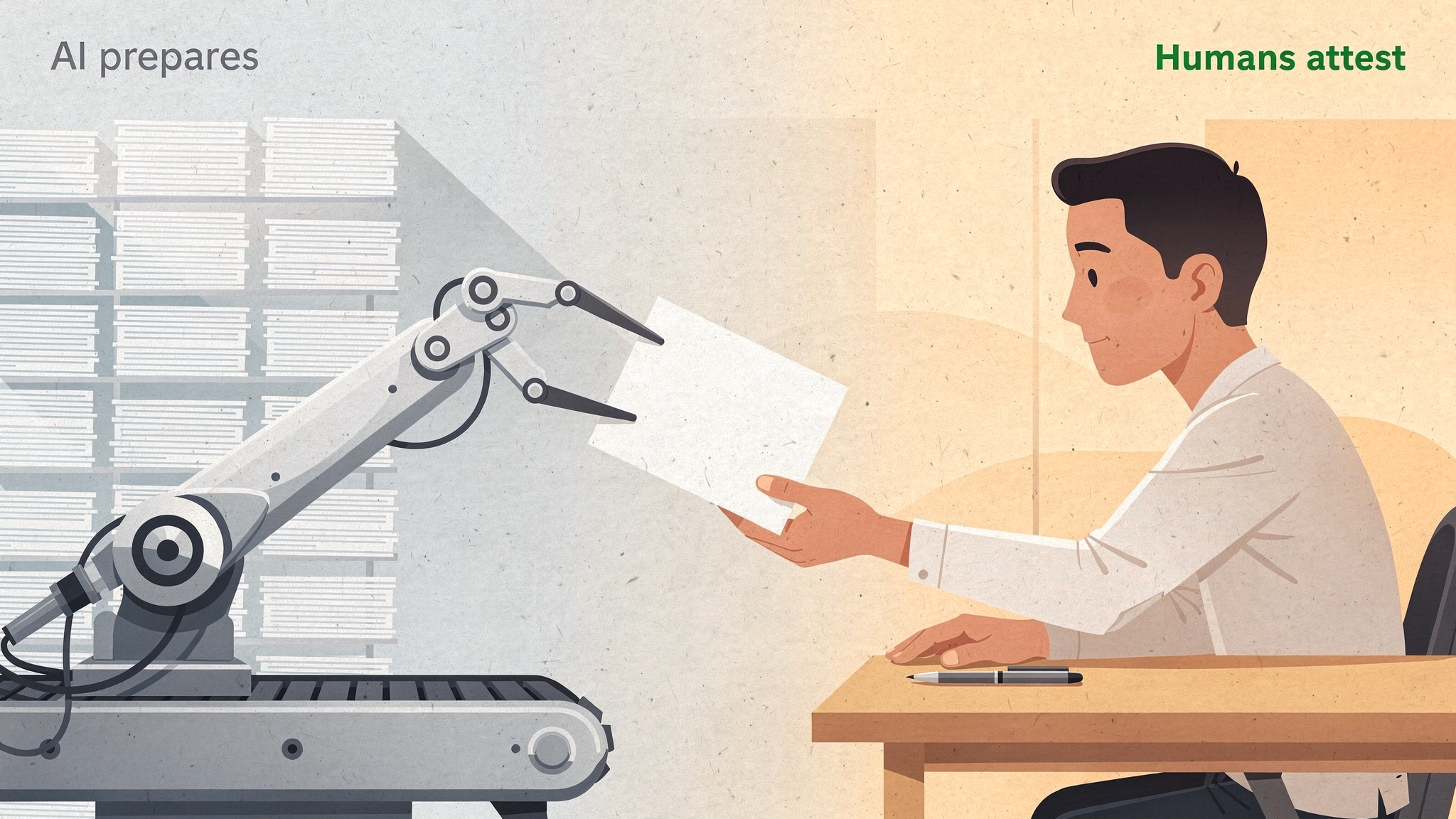
EasyAudit enforces explicit human sign-off at every critical juncture in the compliance lifecycle. Nothing progresses without a real person making a deliberate decision.
Controls require review and approval. When our AI generates controls for an organization, they land in an unaccepted state - they're proposals, not facts. An Admin must review, modify if needed, and explicitly accept each one. The system tracks a full history of every control: creation, scope changes, and acceptance decisions, with timestamps and user attribution.
Risks default to unapproved. Every risk in our AI generated risk assessment is unique to the organization, tailored based on a holistic understanding of the organization, and built with ISO 31000 principles. Once risks are generated, they must be approved by an org admin.
Documents follow a structured lifecycle. Draft → pending review → published. Signatures are required for completion, with constraints to prevent double-signing. Every signature is a distinct, intentional act.
Evidence follows a request → submission → review cycle. Auditor feedback during the audit window is critical. An Auditor creates an evidence request with specific requirements. A User uploads evidence. A separate reviewer explicitly marks it as completed or rejected. Every state transition is audit-logged and user-attributed.
And critically: auditors have read-only access. They can request evidence and view what's been submitted, but they cannot modify it, sign it, or generate it. This mirrors the separation-of-duties principle that all major compliance frameworks demand, and that the platforms cutting corners have entirely collapsed.
How We Use AI, and Where We Don't
We use AI extensively at EasyAudit. Our agentic task system runs asynchronous, long-running operations - control generation, evidence collection, gap remediation, continuous monitoring - with real-time progress tracking.
But our core architectural principle governs all of it: AI outputs are suggestions, never conclusions.
When an Admin initiates control generation, our agentic system builds those controls from the organization's actual context, including their subscribed frameworks, their SOC 2 Trust Services Criteria selections, and their specific infrastructure and risk profile. Controls are generated per EAF Objective (our framework-agnostic control taxonomy), deduplicated across frameworks, and validated against existing mandatory controls to avoid redundancy.
But every generated control lands in an unaccepted state. The AI never writes the auditor's report. The AI never fabricates evidence. The AI never attests to anything. Every AI run is tracked with its status, output summary, and reasoning - a complete record of what automation did and when.
This is a structural guardrail, and there's no path through the system where an AI output becomes a compliance assertion without a human explicitly making it so.
The Ethical AI Position
We believe AI should make compliance more accessible, more continuous, and more rigorous - not less trustworthy. The temptation in our industry is to use AI to skip the hard parts: pre-write auditor conclusions, fabricate board meeting minutes, generate identical reports with names swapped.
We've taken the opposite approach. Our AI does the genuine work, collecting real evidence from live integrations, building controls tailored to each organization's actual environment, and maintaining compliance posture in real time. But every output passes through human judgment before it becomes part of a compliance assertion.
This isn't slower. It's under three hours of customer time to reach audit readiness with EasyAudit. But it's real. Every control was reviewed by a human. Every piece of evidence was uploaded by a real user and verified through a formal review cycle. Every document was signed deliberately, with each signature type representing a distinct level of endorsement.
We think compliance platforms have an ethical obligation to get this right. A compliance certification is a legal assertion that a company's security controls have been examined and found sound. When that process isn't real, the companies carrying it don't know they're exposed, and the customers relying on that certification don't know they're unprotected.
Building guardrails into AI isn't a limitation. It's the thing that makes the AI's output actually worth something.
What This Means for the Industry
The compliance industry is at an inflection point. The companies that will win the next decade are building on real foundations, and their compliance posture should be one of them.
We built EasyAudit for auditors who take their independence seriously, for companies that want compliance they can actually stand behind, and for an industry that deserves better than fabricated reports and rubber-stamped certifications.
If you're evaluating what "real" looks like in compliance automation right now, we are always happy to talk.